
Machine learning (ML) is the engineering practice of building systems that improve on a defined task by fitting models to data, rather than relying only on hand-authored rules. The unit of work is a decision: classify, rank, forecast, detect, or recommend—under a loss that approximates the cost of being wrong. ML sits inside artificial intelligence, but it is not synonymous with AI: many AI systems use ML, and many ML systems never attempt general reasoning.
This guide owns learning-problem framing, the classical and general ML workflow, evaluation discipline, and production skew/drift basics. It does not own hierarchical deep architecture systems (deep learning), neural unit/backprop textbooks (neural networks), or the full sequential-decision RL stack (reinforcement learning—mention only as a boundary). Generative sampling products belong under generative AI.
What machine learning optimizes—newcomers should begin with What is AI
Offline metrics are proxies. Online A/B tests and counterfactual evaluation (when available) closer approximate decision utility—but only after offline gates clear. Skipping offline discipline and “testing in production” transfers risk to users.
Also separate prediction quality from decision policy. Two teams can share a model and disagree on thresholds; that is a product dispute, not an ML API bug. Version policies independently from weights when possible.
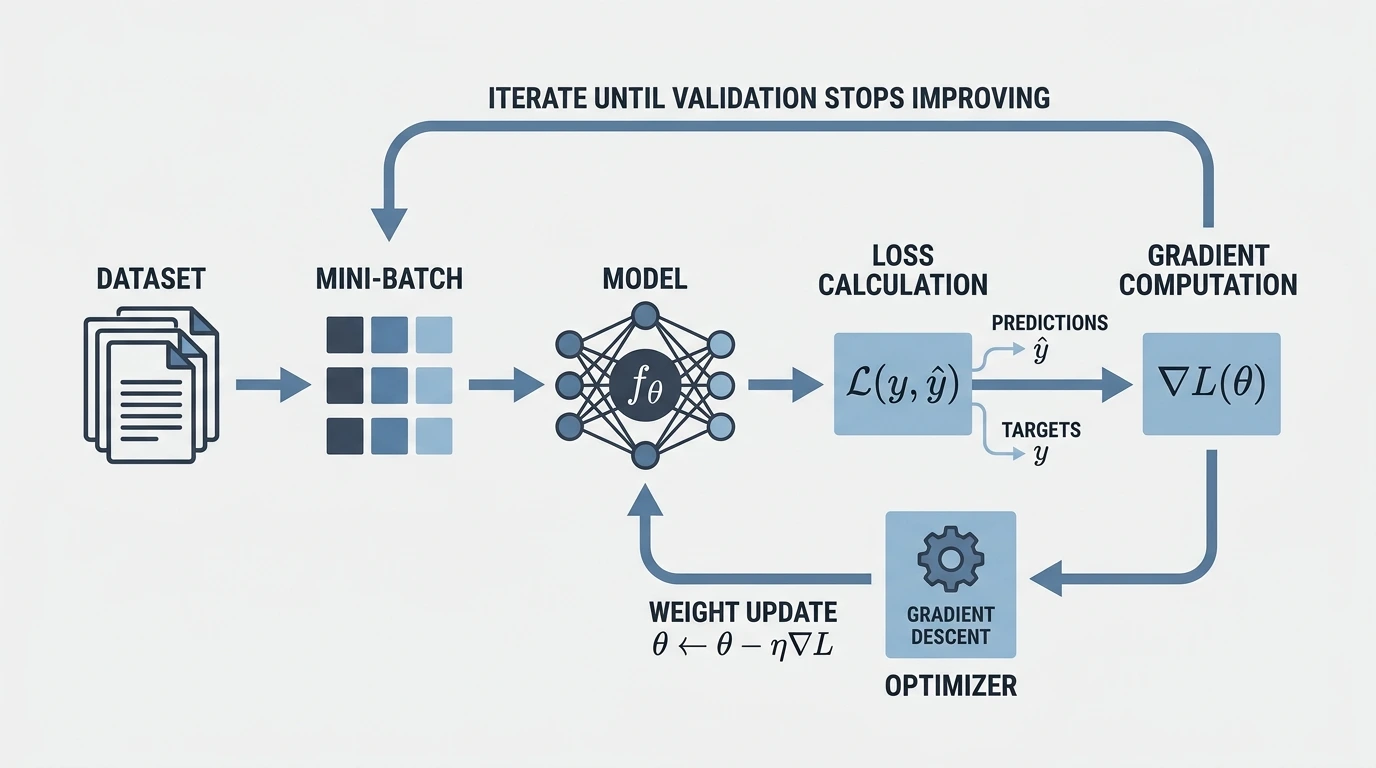
At root, supervised ML searches for parameters θ that make predictions ŷ = f_θ(x) useful under a loss ℓ(ŷ, y) averaged over a data distribution. You never observe the true distribution—only a finite sample—so generalization is the entire game. Unsupervised and self-supervised settings replace explicit y with pretext objectives; the decision still needs a downstream contract.
Optimization is not the goal; decision utility is. A model that minimizes cross-entropy but fails the operating-point precision you need for automation has optimized the wrong proxy. Publish the decision, the cost of errors, and the metric that gates ship before choosing an algorithm.
The learning problem: hypothesis class, data, risk
Non-stationary worlds break the i.i.d. fantasy. Concept drift (P(y|x) changes) and covariate shift (P(x) changes) need different responses: relabel and retrain vs reweight/adapt. Detect which shifted before spending a quarter on a new architecture.
A learning problem has three pieces: a hypothesis class ℋ (what functions you will consider), a data regime (how examples are sampled, labeled, and leaked), and a risk functional (expected loss). Empirical risk minimization approximates risk with the training average, plus optional regularization. Capacity that is too small underfits; capacity that is too large memorizes noise when data are scarce or labels are dirty.
Write the problem before the model: input available at decision time, label definition, positive/negative costs, latency budget, and forbidden features (leakage, fairness, legal). Teams that start with “we will use XGBoost/transformers” skip the only step that makes evaluation meaningful.
Supervised, unsupervised, and reinforcement boundaries
Multi-task and multi-label supervised settings need explicit label dependence modeling. Treating correlated labels as independent can yield incoherent decisions (e.g., mutually exclusive classes both firing). Constraint layers or conditional heads fix what losses alone will not.
Supervised learning maps x→y from labeled pairs. Unsupervised learning finds structure in x (clusters, density, factors) without y—useful for exploration, compression, and anomaly cues, weak as a direct decision without a downstream label. Reinforcement learning optimizes sequential actions under reward; it is a sibling methodology, not a synonym for tool-using software agents. Keep RL’s MDP framing out of this page’s depth.
Semi-supervised and self-supervised regimes blend labeled scarcity with unlabeled abundance. They still require an evaluation label for the decision you care about. Pretext accuracy is not product success.
Train, validation, and test without self-deception
Group leakage is subtle: same user in train and test via different sessions; same hospital across splits; same device firmware. If your unit of decision is a customer, split by customer. Publish the split key in the eval card.
Split protocols must respect dependence: time, entity, site, device, customer. Random splits that leak future into past manufacture fake accuracy. Validation tunes; test judges once—or you burn the test set into an unofficial training set.
Nested concerns: preprocessing fit on train only; threshold tuning on validation; final report on test. Document every transform. If feature stores serve training and production differently, you have invented skew before day one.
Classical algorithm families still in production
Baselines first: majority class, simple heuristic, linear model. If a deep model cannot beat a strong gradient-boosted tree on tabular data under the same splits, you have not earned complexity. Baselines also diagnose label noise—if nothing beats majority, labels may be broken.
Linear/logistic models, generalized linear models, trees and ensembles (random forests, gradient boosting), nearest neighbors, naive Bayes, SVMs, and simple sequence/HMM-style models still ship widely—especially on tabular data with modest samples. They offer strong baselines, faster iteration, and often clearer audits than deep nets.
Trees excel at mixed-type tabular features and nonlinear interactions with limited tuning drama. Linear models excel when you need calibrated probabilities and inspectable coefficients. Deep models win on unstructured perception and large-scale transfer—see deep learning—not as a default for every spreadsheet.
| Family | Often wins when | Watch-outs |
|---|---|---|
| Linear / GLM | Need calibration, sparse signals, audits | Underfits complex interactions |
| Tree ensembles | Tabular, mixed types, nonlinearities | Leakage via target encoding; size/latency |
| k-NN / kernels | Local structure, small data | Scale poorly; metric choice |
| Deep nets | Images, speech, text at scale | Data/ops cost; see DL guide |
Feature work and leakage
Target encoding and aggregations must be computed out-of-fold. Computing encoders on full data before splitting is a classic self-deception. Time-aware features need point-in-time correct joins; otherwise you train on the future.
Features are compressed theories about the world. Good features encode stable causal or strongly predictive structure; bad features encode the label’s future. Leakage examples: using post-decision outcomes, customer service notes written after the event, or IDs that proxy the label. Leakage produces spectacular offline metrics and silent production failure.
Feature stores and pipelines must version definitions. Ad-hoc notebook joins are how two “same” features diverge. For vision and language inputs, “features” may be learned representations—still subject to leakage via train/eval contamination.
Evaluation metrics matched to decisions
For probabilistic forecasts, sharpness and calibration both matter. A model can be calibrated and uselessly uncertain, or sharp and miscalibrated. Choose training losses and post-hoc calibration (Platt, isotonic) deliberately when scores drive automation.
Accuracy lies under imbalance. Precision/recall/F1, ROC-AUC/PR-AUC, log loss, Brier score, ranking metrics (NDCG, MAP), and calibration error answer different questions. Choose from the cost matrix: false approve vs false deny; missed defect vs scrap; ranking quality vs absolute score.
Report operating points, not only curves. If automation fires at score ≥ t, evaluate at that t on slices that matter (segment, geography, time). Average excellence with a broken critical slice is a failed system.
Overfitting, underfitting, and regularization practice
Hyperparameter search consumes validation information. Nested CV or a final locked test prevents optimistic reporting. Log search spaces and seeds; irreproducible “best” models are not assets.
Underfitting: train and test both poor—capacity or features insufficient. Overfitting: train great, test poor—capacity, noise, or leakage. Regularization (penalty terms, dropout in nets, early stopping, tree depth/min-leaf constraints, data augmentation) trades variance for bias deliberately.
Modern overparameterized regimes complicate cartoon U-curves, but honest held-out evaluation does not become optional. Early stopping is a first-class regularizer; treat the stopping rule as part of the model.
From notebook to production: skew and monitoring
Shadow mode—scoring without acting—measures divergence from incumbents before cutover. Canary with kill criteria beats big-bang replacement. Rollback includes features and thresholds, not only model binaries.
Train/serve skew appears when training data, features, or code paths differ from production. Causes: offline joins unavailable online, different defaults, batch vs streaming clocks, stale embeddings, or silent schema drift. Golden path tests—same raw event → same features → same score—catch many failures.
Monitoring covers input distributions, missingness, score distributions, and delayed labels. Drift detection without a decision-owner is theater. When labels arrive late (fraud, credit), use proxy metrics carefully and recalibrate when true labels land.
Infrastructure for scoring at scale is owned elsewhere (AI infrastructure); this page owns the ML-specific skew and label-delay failure modes.
Human labels and feedback loops
Active learning can reduce labeling cost if acquisition targets decision risk, not only model uncertainty on inherently ambiguous cases. Budget labels for rare high-cost errors.
Labels are decisions made by humans or systems with their own error rates. Measure agreement; write guides; adjudicate edge cases. Noise-aware training helps but does not replace ontology clarity.
Feedback loops—using model outputs as future labels—can amplify mistakes or encode policy. If production decisions become training data, quarantine gold sets and monitor for self-fulfilling predictions.
Cost-sensitive and imbalanced learning
Synthetic oversampling can distort densities and leak across folds if done wrong. Prefer careful weighting and thresholding unless you have validated synthetic gains on a clean test protocol.
Class imbalance is common; resampling, class weights, and threshold moves are tools, not magic. Prefer metrics and thresholds matched to costs over blindly maximizing F1. For ranking and retrieval-adjacent tasks, evaluate at the cutoff users see.
Cost-sensitive learning can encode asymmetric losses directly. If costs change (seasonality, policy), thresholds and even training weights need revisit—not only model retrains on a schedule.
When rules or analytics beat ML
Hybrid designs are normal: rules for eligibility, ML for prioritization inside the eligible set. Do not force a single model to encode hard constraints that software already knows exactly.
Prefer deterministic rules when logic is stable, complete, and audited (eligibility checks, hard compliance gates). Prefer analytics dashboards when the need is explanation of aggregates, not per-entity automation. Prefer optimization/OR when constraints and objectives are explicit.
ML earns complexity when variation overwhelms rules, signals are statistical, and you can afford labels and monitoring. “ML by default” is how teams replace a working SQL filter with an unowned classifier.
Routing into deep learning and generative systems
If stakeholders ask for “AI” but the job is a calibrated tabular score, stay on the ML trunk and save generative budget for interfaces that need language or media artifacts.
Route to deep learning when unstructured inputs and representation learning dominate. Route to neural networks when you need unit/architecture mechanics. Route to generative AI when the artifact is sampled content rather than a score. Route to computer vision for vision task metrics and cameras. Classical ML remains the right trunk for many tabular decisions.
A mature stack often composes: rules for hard gates, ML for risk scores, retrieval for facts, generative models for drafts. Ownership clarity prevents every team from reinventing a private “AI platform” noun.
Governance for predictive systems
Incident reviews should ask whether the failure was data, label, feature skew, threshold, or model class. Blaming “the AI” erases the only categories you can fix.
Predictive systems need model cards/eval cards: intended use, out-of-scope uses, metrics, slices, owners, refresh cadence, and known failure modes. Change control for features and thresholds belongs beside change control for code. High-impact scores (credit, employment, healthcare-adjacent) inherit stricter review—coordinate with policy owners without turning this page into an ethics treatise.
Practical workflow from problem to production
A durable sequence: (1) write the decision contract; (2) define labels and splits; (3) ship a baseline; (4) iterate features/models against validation; (5) lock test evaluation; (6) shadow; (7) canary; (8) monitor and schedule refresh. Skipping ahead to (4) with a fashionable model is how notebooks fail in production.
Staff roles: decision owner, data owner, model owner, platform owner. If one person is all four, the system is fragile. ML platforms help, but they do not replace the decision contract.
Documentation is part of the artifact: data dictionary, feature list with point-in-time semantics, metric definitions, and known slices. Future you will retrain under stress; leave a trail.
Common failure gallery
Leakage via post-outcome fields. Random splits on time-series. Accuracy on 99% negative class. Thresholds chosen on test. Training on population A, serving on population B. Silent schema changes in upstream events. Labelers without a guide. Feedback loops that encode yesterday’s biased policy. Each failure is preventable with the disciplines above.
When a metric collapses after launch, resist immediate architecture swaps. First verify skew, label delay, and segment mix. Most “model got dumb” incidents are distribution or pipeline incidents.
Machine learning earns trust when the learning problem, splits, metrics, and production assumptions are explicit. Algorithm choice is downstream of that clarity. Keep deep architecture systems, neural mechanics, and generative product patterns in their own guides—and keep this page as the decision-centric ML trunk of the Knowledge library.
Algorithm selection as an engineering checklist
Start from constraints, not fashion. Sample size, feature type mix, latency SLO, interpretability need, and non-stationarity dominate algorithm choice. With n in the hundreds and mixed tabular features, strong tree ensembles or regularized linear models usually beat deep nets. With millions of images, the reverse is true—and that work belongs primarily in deep learning and computer vision.
Second-order choices: probabilistic vs hard labels, ranking vs point prediction, online vs batch learning. An online learner that updates every event can track drift but needs careful guardrails against poisoning and feedback loops. Batch retrains are simpler to audit. Pick the operational model you can staff.
Third: ensemble vs single model. Stacking and blending can lift metrics and destroy debuggability. Prefer a single strong model until a clear residual error class remains. When you ensemble, monitor each member; silent degradation of one member is a common production surprise.
Data-centric ML practices that actually move metrics
Many “algorithm projects” are data projects in disguise. Fixing label definitions, removing leaked features, balancing slices, and cleaning join keys often beat a week of hyperparameter search. Maintain a data issue log beside the model changelog.
Slice-aware collection beats bulk collection: spend labeling budget on rare high-cost errors and underperforming segments. Global average metrics will not tell you where to spend.
Synthetic data can help rare geometries and privacy-preserving demos, but synthetic test sets cannot certify production readiness. Always keep a real holdout. Document generators and their failure modes if synthetic data enters training.
Calibration, ranking, and decision policies
When scores trigger automation, calibration is part of the product. Temperature scaling and isotonic regression are post-hoc tools that need validation data not used for training. Recalibrate after major distribution shifts.
Ranking systems optimize order, not absolute probability. Mixing ranking losses with probability-consuming downstream policies without conversion logic creates threshold chaos. Be explicit whether the model outputs a score for ordering or a probability for utilities.
Policy layers—business rules on top of scores—should be tested as carefully as models. A correct model with a wrong policy still harms users. Version and evaluate the composed system.
Team interfaces: ML, product, and platform
Product owns the decision and the cost matrix. ML owns the model and eval protocol. Platform owns feature serving reliability and latency. Security/privacy owns allowed features and retention. Write RACI for launches. Ambiguous ownership is how drift alerts page the wrong person at 2 a.m.
Shared vocabulary prevents false conflicts: “accuracy” vs “utility,” “drift” vs “bug,” “bias” as statistical parity vs legal fairness standards. This guide stays technical; legal standards belong with policy specialists—but engineers must know when to escalate.
Time, causality, and why correlational ML still ships
Most production ML systems are correlational: they exploit patterns that predict well enough under a stable regime. Causal identification is stricter and often unnecessary for ranking spam or recommending similar items—yet catastrophic when interventions change the world the model was fit on (pricing, medical treatment suggestions, enforcement policies).
Ask explicitly: will we act on the prediction in a way that changes future x or y? If yes, plan for offline policy evaluation, guarded rollouts, or causal methods. If no, correlational ML with strong monitoring may suffice. Pretending every classifier is causal theater; ignoring intervention effects when you intervene is negligence.
Time-series forecasting deserves specialized protocols (backtesting, rolling origins, seasonal splits). Do not treat forecast problems as i.i.d. classification with a random split. Leakage through future covariates is endemic in forecasting notebooks.
Imbalance, rarity, and the economics of errors
Rare-event problems (fraud, failure, disease coding) tempt exotic architectures when the bottleneck is labels and features for the rare class. Invest in better rare-class examples and cost-aware thresholds before deep stacking. Evaluation must use precision-recall thinking and dollar-weighted errors, not accuracy.
Changing base rates—fraud rings evolve, marketing shifts traffic—break thresholds overnight. Monitor positive rates and recalibrate. A fixed threshold on a drifting score distribution is a quiet incident generator.
Human-in-the-loop review queues are part of the ML system: capacity planning for reviewers, SLA for reviews, and sampling strategies for audit. If review capacity is zero, you do not have a safe automation design—you have a hope.
Reproducibility and experiment tracking
Record dataset versions, code commits, hyperparameters, random seeds, and metric definitions. “We got 0.91 once” is not a result. Prefer deterministic pipelines where feasible; where nondeterminism remains (GPU kernels), report variance across seeds.
Experiment trackers help, but only if the decision contract and split logic are logged too. Hyperparameter sweeps without a locked test protocol optimize noise. Cap the number of test peeks; treat test as scarce.
When promoting a model, store the exact feature schema hash and preprocessing digest. Production should refuse to score if schema drifts beyond tolerance—fail closed beats silent wrong scores.
Closing: ML as decision engineering
Machine learning succeeds as decision engineering under uncertainty: clear contracts, honest splits, metrics that match costs, baselines before complexity, and production assumptions that are tested. Deep learning, neural mechanics, generative systems, and RL extend this trunk; they do not replace it.
Keep this page as the trunk. Link outward for specialized depth. When a project cannot state its decision and cost matrix, it is not ready for a model—however impressive the demo.
Worked sketches (patterns, not templates)
Credit risk ranking: tabular supervised learning; strong tree or linear baseline; calibration mandatory; time-based splits; policy thresholds owned by risk; monitor approval rates by segment. Generative models are irrelevant to the score itself.
Churn propensity: supervised tabular; leakage risk from post-churn tickets; evaluate at campaign capacity k (precision@k); combine with rules for contractual retention offers.
Manufacturing defect triage: may start classical on sensor tables; escalate perception pieces to computer vision when images dominate; keep decision metric at escape vs scrap cost.
Support ticket routing: text classification may use classical TF-IDF linear models or deep text encoders; still an ML decision problem with confusion costs between queues. Generative drafting is a separate surface under generative AI.
These sketches show why ML remains a trunk discipline even in a generative era: many valuable decisions are scores and routes, not sampled artifacts.
Anti-patterns checklist
Training on the test set via repeated peeks. Random splits on temporal data. Accuracy under 1% positives. Leaky target encodings. No baseline. No owner for thresholds. No monitoring for missingness. Retraining on feedback without gold quarantine. Replacing rules that encode hard law with a fuzzy classifier. Each item should be a launch-review question with a named answerer.
Finally, treat ML documentation as an interface between research iteration and operational reality. A short eval card that names the decision, split key, metric, slices, owner, and refresh trigger prevents months of archaeology when metrics move. Pair it with a rollback plan that includes features and thresholds. Organizations that keep those artifacts current compound learning; organizations that only keep notebooks compound myth.
As the Knowledge graph densifies—with embeddings, vector databases, and reinforcement learning joining later in Batch 2—return here for the shared ML trunk: problem framing and evaluation honesty do not go out of date when new paradigms arrive. New paradigms change hypothesis classes; they do not retire the need for a decision contract.
Use launch reviews as forcing functions: no decision contract, no split key, no baseline, no monitoring owner—no ship. That discipline scales across classical and deep systems alike. It is also how a Knowledge library stays coherent: each specialized guide assumes this trunk rather than rewriting it.
If you are new to ML, learn in this order: frame a decision; assemble honest splits; ship a baseline; add complexity only when evaluation demands it; instrument production before celebrating offline gains. That sequence is older than any current architecture fad—and it still separates durable systems from demos. Master it before optimizing model fashion; the contract is the scarce asset, not the architecture diagram. Write the contract first, measure second, model third—then keep measuring after the model ships into the real traffic mix where base rates, adversaries, and messy joins live. That is the only environment that counts for real machine learning systems running in production traffic day after day in the wild.
References and further reading
- Hastie, T., Tibshirani, R., & Friedman, J. The Elements of Statistical Learning.
- James, G., et al. An Introduction to Statistical Learning.
- Provost, F., & Fawcett, T. Data Science for Business (decision-centric metrics).
- Google. Rules of Machine Learning.
- NIST. AI Risk Management Framework (organizational context for predictive systems).