
Generative AI refers to models and products that sample new artifacts—text, images, audio, video, code, molecules, and more—from learned distributions conditioned on inputs such as prompts, images, or structured controls. Text chat products in conversational AI are a common application surface. Frontier generative APIs from vendors such as OpenAI illustrate the product pattern without defining the category. Unlike purely discriminative systems that output labels or scores, generative systems produce content whose quality is judged by open-ended rubrics: usefulness, faithfulness, safety, style, and originality constraints.
This guide owns generative modeling across modalities at product altitude, controllability stacks, open-ended evaluation, fluent failure modes, safety/provenance signals, and when generative approaches should lose to retrieval or discriminative models. It does not own tokenizer/pretrain/RLHF deep dives (language-model specialty), diffusion sampler mathematics encyclopedias (image-generation specialty), or agent tool-security encyclopedias (AI agents). For capability-map orientation see artificial intelligence; for grounded evidence pipelines see RAG; for serving substrates see AI infrastructure.
What “generative” means versus discriminative prediction—see also What is AI
From a systems view, generative components increase entropy of outputs on purpose. That creativity is valuable for ideation and brittle for compliance. Gate creativity with policies matched to the decision: high entropy for brainstorming canvases; low entropy with schemas for ledger writes.
Also distinguish conditional generation (given a prompt or image) from unconditional sampling. Most products are conditional. Unconditional demos impress; conditional eval on your prompts decides ship readiness.
Discriminative models estimate p(y|x) for constrained y (class, rank, risk). Generative models estimate or sample from distributions over high-dimensional artifacts—sequences, pixels, waveforms—often via autoregression, diffusion, masked reconstruction, or latent variable formulations. The product implication: outputs are not single decisions; they are artifacts that enter human workflows and other systems.
Hybrid products abound: a discriminative filter gates a generator; a generator drafts and a classifier scores safety; a retriever supplies evidence a generator verbalizes. Calling everything “generative AI” erases those controls. Name which component samples and which component decides.
Evaluation changes with the shift. Accuracy and AUC are insufficient. You need human preference protocols, automatic proxies with known blind spots, faithfulness checks when claims are made, and abuse tests when open-ended outputs can harm.
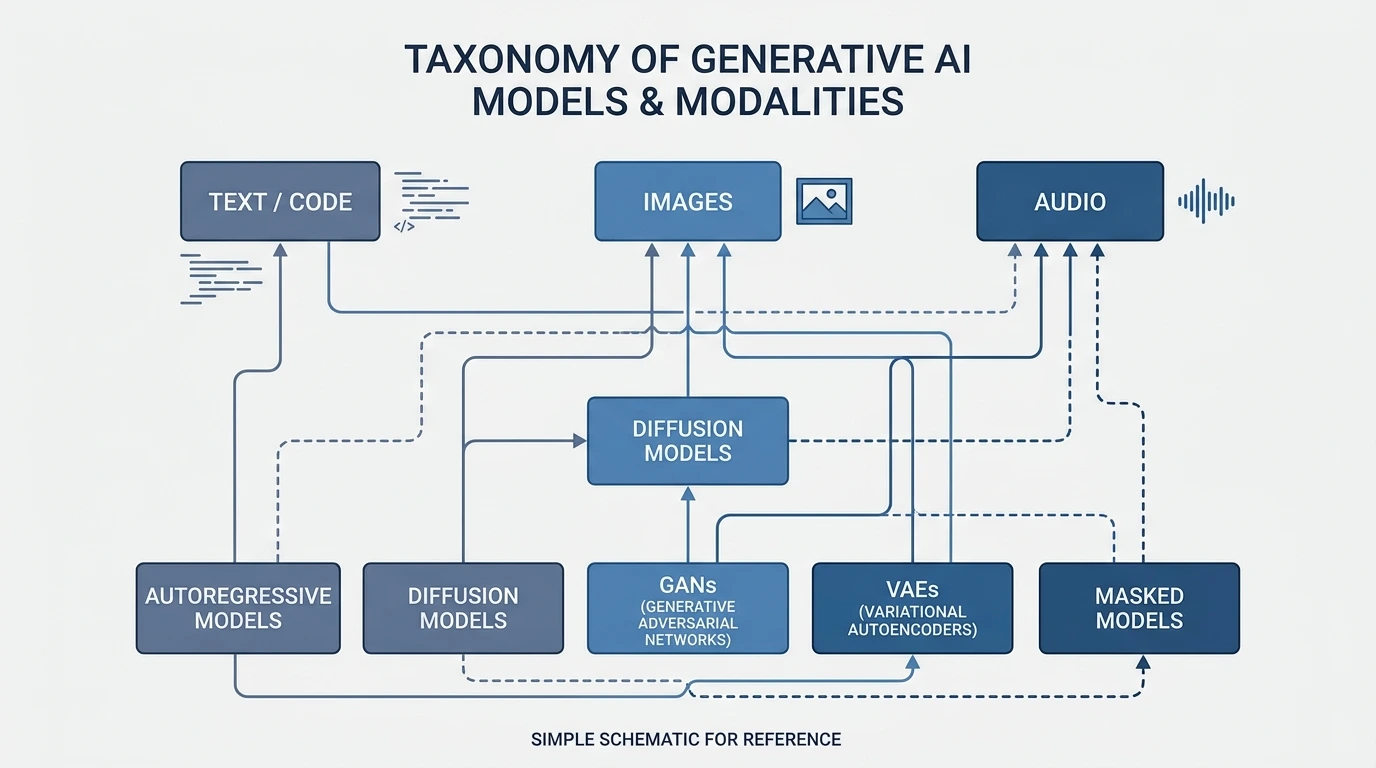
Modality map for generative systems
Cross-modal products should declare a primary modality for policy. A “chat that can draw” still needs image policy enforcement at the image tool boundary. A “camera app that narrates” needs vision privacy rules even if the visible UX is text.
Latency budgets differ wildly: a 200ms text completion feels different from a 10s image render. Set expectations in UX; hiding progress invites duplicate submissions that multiply cost and abuse surface.
Modalities differ in failure modes and controls:
- Text / code: fluent falsehoods, prompt injection, insecure code suggestions, leakage of training snippets.
- Image / video: deepfakes, IP style mimicry, unsafe visual content, identity misuse.
- Speech / music: voice cloning consent issues, deepfake audio, copyrighted melody regurgitation risks.
- Structured / scientific: invalid molecules or designs that look plausible; need validators.
- Multimodal: cross-modal inconsistency (caption disagrees with image) and compounded safety filters.
Do not assume a text safety stack transfers unchanged to image or audio. Filters, detectors, and review UX are modality-specific. Multimodal systems need joint policies: blocking text that requests a disallowed image is not the same as detecting the image itself.
Vision discriminative tasks (detect, segment) remain under computer vision; generative image synthesis product patterns live here at altitude and in specialized image guides when published.
Paradigms at product altitude: AR, diffusion, masked, hybrid
Serving implications: AR benefits from KV caching and continuous batching; diffusion benefits from step reduction distillations and efficient attention backends; masked models may suit infilling editors. Your SRE runbooks should name the paradigm so on-call knows which knobs exist (max tokens vs diffusion steps).
Quality implications: reducing diffusion steps or AR max tokens is a product change, not only an infra tweak—re-eval when you change them.
Autoregressive (AR) models generate token by token, conditioning on prior tokens—dominant for language and increasingly for other discrete sequences. Diffusion models iteratively denoise from noise toward samples—dominant for many image systems and expanding elsewhere. Masked models reconstruct corrupted spans. Hybrids combine ideas (e.g., AR language with diffusion vision).
Product teams rarely re-derive these methods; they choose APIs and serving constraints. Still, paradigm shapes latency (iterative diffusion steps vs single AR pass with KV cache), controllability (classifier-free guidance vs logit processors), and failure modes (exposure bias vs mode collapse-like artifacts).
When vendors rename paradigms for marketing, ask for the sampling procedure, typical step counts, and how controls are applied. Mechanism beats branding.
Controllability stack: prompts, adapters, classifiers, hard constraints
Decode-time controls include temperature, top-p, logit bias, stop sequences, and grammar constraints. Document defaults per product surface. Global “temperature 0.7” folklore is not a control strategy. For code and JSON, prefer constrained decoding validated on the server.
Classifier gates can be input filters, output filters, or both. Measure false block rate on legitimate business prompts; overrefusal destroys adoption and encourages shadow IT use of consumer tools.
Controllability is layered. Soft controls: prompting, few-shot exemplars, system instructions. Medium controls: adapters/LoRA-style specialization, preference-tuned variants, steerable decoding. Hard controls: schema-constrained decoding, grammar/FSM constraints, allowlisted tools, server-side validators, and refusal policies enforced outside the model.
Never rely on soft controls alone for safety-critical or compliance-critical behavior. Models can be persuaded; validators cannot be sweet-talked if implemented correctly. Prefer structured outputs validated against schemas before side effects.
Personalization adapters improve style fit and increase governance burden: who may load which adapter, how adapters are evaluated, and how they are revoked. Treat adapters as shippable artifacts with versions and owners.
Evaluation beyond accuracy for open-ended outputs
Inter-annotator agreement on rubrics must be measured. If raters disagree, your ship gate is noise. Train raters with exemplars of borderline cases. For code generation, execution-based tests beat prose rubrics when sandboxes are available.
Online eval: sample production prompts (with privacy controls), score asynchronously, and alert on drift. Offline-only eval misses prompt distribution shift after launch marketing changes the user mix.
Build a rubric family: task success (did it solve the user job?), preference (pairwise human or carefully validated proxy), factuality/faithfulness when claims appear, safety (policy violations), and operational metrics (latency, cost, abstention rate).
Automatic metrics (BLEU-like, embedding similarity) are weak for open-ended quality; use them as smoke tests, not ship gates. LLM-as-judge helps at scale but inherits judge biases—calibrate against humans on a held-out set and monitor judge drift.
Golden sets should include adversarial prompts, multilingual cases, and “should abstain” items. Report slices. A generator that wins average preference while failing a regulated slice is not shippable for that slice.
Fluent failure modes: falsehoods, leakage, preference gaming
Mitigations compose: retrieval for facts, tools for calculations, validators for schemas, and UI for uncertainty. Removing any layer because “the new model is smarter” is a recurring incident precursor. Smarter models still need boundaries.
Sycophancy tests: ask for contradictory user beliefs and see whether the model flips inappropriately. Overconfidence tests: ask unknowable questions and score abstention. Put both in regression packs.
Fluency amplifies trust. Falsehoods look authoritative; insecure code looks clean; fabricated citations look real. Prefer retrieval-grounded answers for enterprise facts via {K(“rag”,”RAG”)}, and teach UIs to separate drafting from asserting.
Training-data leakage and memorization risks appear as near-verbatim spans. Evaluate with canaries and known-probe sets where lawful and contracted. Preference gaming appears when models optimize for judge scores or thumbs-up while becoming sycophantic or evasive. Track sycophancy and overrefusal as first-class regressions.
Distribution shift hits generators when user slang, product names, or visual styles drift. Continuous eval on fresh samples beats one-time launch benches.
Safety, abuse, and provenance signals
Incident response needs prompt/output retention policies that balance privacy and forensics. Define retention windows per risk tier. Provide user reporting that routes to trained reviewers quickly. Track time-to-mitigate for viral abuse patterns.
Child safety and self-harm policies require specialized playbooks and model behaviors; general “be helpful” assistants are the wrong default. Coordinate with platform trust-and-safety specialists before launch.
Safety stacks combine policy, training-time alignment, inference-time filters, rate limits, and human review. Red-team across jailbreaks, multi-turn coercion, and multimodal smuggling. Measure attack success rate, not only anecdotal refusals.
Provenance signals—watermarking, content credentials, audit logs of prompts/outputs—help downstream trust and abuse response. No signal is perfect; combine technical marks with policy and platform enforcement. Disclose limitations honestly.
Abuse includes scams, non-consensual intimate imagery, malware assistance, and child sexual exploitation material—zero tolerance categories need hard blocks and reporting paths. Product teams must know escalation contacts before launch.
IP and training-data constraints (descriptive, not legal advice)
Enterprise deployment checklists often include: whether outputs are assigned to the customer; whether prompts are retained; subprocessors; and regional processing. Align marketing claims with the DPA you actually sign. Technical teams should implement the mode buttons legal sells—zero retention must be real.
Generative systems raise copyright, likeness, and trademark issues that are jurisdiction-specific. This page is not legal advice. Operationally: document data provenance for training/fine-tuning, respect opt-outs and licenses you agreed to, provide complaint channels, and avoid promising “risk-free” IP outcomes.
Enterprise buyers increasingly ask about training-data sources, retention of prompts, and whether their data is used to train shared models. Answer with precise contractual language and technical controls (private tenants, zero-retention modes) you can actually enforce.
Product patterns: assist, generate, transform, simulate—including game content assist
Assist patterns pair well with side-by-side diff UIs and explicit “insert” actions. Generate patterns need asset management: versions, licenses, and takedown. Transform patterns need round-trip tests (translate there and back) and terminology glossaries. Simulate patterns need clear labeling that content is synthetic when shown to end users.
Four recurring patterns: assist (drafts for humans), generate (artifacts as deliverables), transform (rewrite, translate, restyle), and simulate (synthetic users, environments, data). Assist patterns usually need lighter autonomy and heavier verification UX. Generate patterns need stronger brand/safety controls. Transform patterns need fidelity metrics. Simulate patterns need bias and validity checks so synthetic data does not launder false confidence.
| Pattern | User job | Primary risk | Control emphasis |
|---|---|---|---|
| Assist | Speed human draft | Automation bias | Review UX; citations |
| Generate | Ship artifact | Safety/IP/brand | Filters; provenance |
| Transform | Preserve meaning | Silent distortion | Fidelity eval |
| Simulate | Synthetic scenarios | Invalid distribution | Validator + coverage |
Latency and cost shapes of generative serving
Chargeback models should attribute generator spend to product surfaces. Shared “AI budgets” without attribution invite tragedy of the commons. Provide per-feature quotas and visible cost in internal admin tools.
Graceful degradation: fall back to templates or retrieval-only answers when generators time out. Silent empty failures teach users to retry storms.
Autoregressive decoding cost scales with output tokens; time-to-first-token and time-per-output-token both matter. Diffusion cost scales with steps and resolution. Speculative decoding, caching, quantization, and smaller specialized models change the frontier—see {K(“ai-infrastructure”,”AI infrastructure”)} for substrate economics.
Product design influences cost as much as kernels: default to shorter drafts, stream tokens, cache repeated prefixes, and avoid unbounded “keep generating” loops. Agents that call generators repeatedly need budgets from the agents guide.
When retrieval or discriminative models should win
Decision tree sketch: If output must be entailed by private docs → RAG (+ optional generate). If output is a yes/no or score → discriminative. If output is creative artifact under policy → generative with filters. If output is a known schema fill from forms → software. Revisit when requirements change; do not marry the first demo.
Prefer retrieval when the system of record is documents you must cite and ACL. Prefer discriminative models when the output is a decision score with a threshold. Prefer classical software when rules are complete. Generators shine at flexible interfaces and novel artifacts—not at being undependable databases.
A common win: discriminative intent routing + RAG + constrained generation. A common loss: pure generation against private enterprise facts without retrieval.
Composition with agents and RAG (boundaries only)
Sequence diagrams help teams avoid double ownership: agent runtime owns loop; RAG owns index; generator owns sampling; policy engine owns allow/deny. Clear ownership shortens incidents.
RAG owns evidence pipelines; generators consume assembled context. Agents own tool loops and permissions; generators propose tool calls that gateways must authorize. Do not re-implement those control planes inside a generative-AI essay. Compose explicitly: generator as component, not as omniscient runtime.
Vendor evaluation for generative systems
Include exit drills: export fine-tunes/adapters if offered, replay golden sets on an alternate model, and measure quality drop. Contractual “we are best” language without portability is lock-in. For open-weight self-host options, include infra staffing reality from the infrastructure guide.
Bake off on your rubrics: quality slices, safety attack suites, latency/cost at your traffic shape, data retention terms, exportability, and incident history. Freeze prompts and judges. Demand failure galleries. Prefer vendors who support constrained decoding and enterprise tenancy controls you can test.
Scorecards should weight your risk tier. A consumer image toy and a hospital drafting assistant should not share the same winning vendor by default.
Operating a generative feature after launch
Post-launch operations include prompt/config change control, abuse monitoring, quality sampling, cost anomaly detection, and model/provider failover tests. Treat prompt changes like code deploys: review, stage, canary, rollback. Hot-editing production system prompts without audit is a reliability bug.
User feedback hooks should capture reproducible contexts (prompt, model version, retrieval IDs if any) under privacy rules. Thumbs-down without context wastes analyst time. Close the loop to golden-set updates.
Regional and language expansion is a new launch, not a checkbox. Re-run safety and quality suites per locale. Generators that look polished in English can fail spectacularly elsewhere.
Designing abstention and escalation
Abstention is a feature. Define when the system should refuse, ask clarifying questions, or route to humans. Measure abstention precision/recall against policy. Systems that never abstain will eventually assert harmfully; systems that abstain indiscriminately will be abandoned.
Escalation paths must be staffed. A “contact support” link into an unread queue is not a safety control. Publish internal SLAs for high-risk categories.
Synthetic media literacy for product teams
Product teams should understand deepfake risk even if they do not ship image generators: attackers will use external generative tools against your users (support scams, fake invoices). Defenses include verification workflows, out-of-band confirmation for high-risk actions, and user education. Generative AI literacy is broader than your own model feature.
Internally, watermarking and detection are arms races; do not claim perfect detectability. Combine signals with process controls.
Roadmap guidance tied to Batch 1 neighbors
If your roadmap is generative-heavy, schedule parallel investment in RAG for facts, agents only where tools are justified, infrastructure for cost/latency, and the artificial-intelligence operating model for governance. Generative features without those neighbors become expensive chat toys.
Keep modality specialists in the loop as you deepen image, speech, or code surfaces. This guide stays at cross-modality product altitude so specialized pages can go deep without rewriting the controllability story.
Ship generative value where artifacts unlock leverage; constrain sampling where decisions demand entailment; evaluate with rubrics that match user jobs; and operate with the same seriousness you would apply to payments—because fluent mistakes scale as fast as fluent help.
Worked examples of control choices
Marketing copy assistant: assist pattern; soft style prompts + brand glossary retrieval; human publish gate; measure brand-violating rate and edit distance from drafts. Generative freedom is high because humans remain in the loop.
Customer refund letter generator: transform/assist with low entropy; retrieve policy via RAG; constrain amounts with server-side calculators; prohibit model-authored money fields; log citations. Generative freedom is low.
Image campaign tool: generate pattern; strong visual safety filters; likeness opt-in checks; provenance metadata; review queue for paid media. Cost and latency shaped by resolution and diffusion steps—expose those knobs to operators.
Code migrate helper: assist pattern; sandboxed execution tests; secret scanning on outputs; repository ACLs; no autonomous commits. Pair with agent controls if tool calls can write branches—budgets and HITL required.
These examples show controllability as a design surface: you choose entropy, validators, and human gates based on blast radius—not based on which model is trendy.
Organizational skills for generative products
Hire or develop: rubric designers, red-teamers, evaluation engineers, trust-and-safety operators, and platform engineers who understand serving knobs. A single “prompt engineer” cannot cover this set. Pair creative PMs with measurement owners.
Create a generative quality guild that shares golden-set practices across text, image, and code surfaces so each team does not reinvent weak metrics. Guilds should also share incident patterns—jailbreaks travel across products.
Procurement and legal need literacy sessions on retention modes, watermark limits, and IP complaint workflows. Technical accuracy in contracts prevents unsellable promises.
Measurement that resists Goodhart effects
If you optimize only thumbs-up, models become sycophantic. If you optimize only safety refusals, models become useless. If you optimize only latency, quality collapses. Use a balanced scorecard with floor constraints (safety must pass) and target bands (quality/cost/latency).
Rotate evaluation items so teams cannot overfit the golden set. Hold out a sealed set reviewed quarterly. For LLM-as-judge, rotate judges or blend judges to reduce circularity.
Publish internal quality reports with failure galleries. Culture that hides failures ships them to customers instead.
Future-facing but grounded expectations
Expect continuing gains in multimodal fluency and tool use. Do not expect generators to become reliable systems of record without retrieval and ACLs. Do not expect watermarks alone to solve authenticity. Do not expect one model to be best across all rubrics and cost envelopes.
Plan architectures that swap generators behind stable interfaces: prompt templates, tool schemas, eval harnesses, and policy engines. Model churn is certain; interface stability is a choice.
Align generative roadmaps with artificial intelligence risk tiers and AI infrastructure unit economics so features remain operable as usage scales.
Launch checklist for a generative surface
Before production traffic: written risk tier; policy mapped to filters; golden set with adversarial and abstain cases; human rater agreement measured; latency/cost budgets load-tested; retention mode verified; abuse reporting path staffed; rollback plan for model/prompt; provenance settings documented; accessibility review for streaming UIs; locale plan if multilingual; security review for injection if tools/RAG exist.
During canary: watch safety violation rate, thumbs-down reasons, cost per session, p95 TTFT/TPOT, and support ticket themes. Kill criteria must be numeric and pre-committed. After full launch: weekly quality sampling and monthly red-team refresh.
If any checklist item is waived, record the waiver owner and expiry. Eternal waivers are how temporary demos become permanent risk.
Anti-patterns specific to generative AI
Shipping without abstain behavior. Using generators as databases. Trusting soft prompt policy for money movement. Measuring only average preference. Hiding model/prompt versions. Letting agents call generators without budgets. Claiming IP safety absolute. Ignoring modality-specific filters. Treating watermarking as solved authentication. Optimizing solely for demo wow.
Each anti-pattern has a concrete counter-artifact listed earlier in this guide—use the checklist as a forcing function in launch reviews.
Closing
Generative AI is powerful because it samples flexible artifacts quickly. It is dangerous for the same reason. Controllability, evaluation, and operations determine whether that flexibility becomes leverage or liability. Keep this guide focused on those cross-modality product truths, and deepen in specialized Knowledge pages when a single modality’s mathematics or market demands it.
Choose entropy deliberately. Constrain what must be true. Measure what users actually need. Operate after the launch party ends. That is generative AI as an engineering discipline rather than a slogan.
Appendix: mapping generative features to Batch 1 guides
Use this quick map when filing tickets. Sampling quality and modality controls → this generative AI guide. Enterprise facts and citations → RAG. Tool loops and permissions → AI agents. Perception metrics for cameras → computer vision. Representation learning systems → deep learning. Network mechanics → neural networks. GPU/fabrics/serving economics → AI infrastructure. Capability portfolio and vendor claim literacy → artificial intelligence.
Filing work against the wrong guide produces duplicated essays and missed controls. The V2 overlap rules exist so Batch 1 remains a coherent system rather than eight clones of one article.
When a feature spans guides, write a short ownership sentence in the PRD (“RAG owns index freshness; GenAI owns draft style; Agents own refund tool permissions”) and keep implementation split accordingly. Shared interfaces beat shared ownership mush.
That mapping discipline is the last control in the stack: editorial and engineering clarity about which layer is changing. With it, generative AI can move fast without erasing the rest of the Knowledge system that makes it safe to operate.
One more operational note: generative features change user expectations overnight. Support scripts, sales claims, and help-center articles must update in the same release train as the model. Mismatched claims (“it always cites sources”) when the surface does not retrieve are brand and compliance defects—not mere documentation lag.
Keep a shared changelog for model IDs, prompt versions, filter versions, and known limitations visible to support. When users report a failure, those versions make reproduction possible. Without them, every ticket becomes archaeology. Version visibility is a support feature as much as an engineering feature; fund it like one and review it in every launch checklist without exception every single time, period.
References and further reading
- Goodfellow, I., et al. (2014). Generative Adversarial Networks (historical paradigm marker).
- Ho, J., et al. (2020). Denoising Diffusion Probabilistic Models.
- Brown, T., et al. (2020). Language Models are Few-Shot Learners.
- OWASP. OWASP Top 10 for LLM Applications.
- NIST. AI Risk Management Framework.