
Artificial intelligence (AI), in engineering and product practice, is the set of techniques and systems that perform tasks associated with perception, prediction, generation, planning, and interaction—under explicit objectives, data regimes, and operational constraints. This page is a systems-altitude map: what capabilities exist, how applications assemble around models, where boundaries with machine learning and generative systems lie, and how to read vendor claims without theater.
It does not replace a foundational primer on “what intelligence means,” nor does it duplicate deep learning training systems, neural networks unit mechanics, RAG pipelines, AI agents control loops, computer vision task metrics, or AI infrastructure fabrics. Those guides own their layers. On-device constraints deepen under edge AI. Here the ownership is the capability map, application assembly stack, boundary language, and evidence checklist for claims.
Engineering and product working definition of AI—start with What is AI if you need an on-ramp—pair with the glossary guide
Write AI requirements as decision requirements: inputs available at decision time, allowed latency, maximum false positive/negative costs, audit needs, and languages/locales. Technology choice follows. Starting from “we need a foundation model” inverts the order and locks you into generative patterns when a ranker would do.
Governed AI programs define prohibited uses early (biometric categorisation where illegal, unreviewed medical advice, etc.). Capability maps without prohibited-use lists invite inventive product managers to ship risk.
For builders, AI is usefully defined by delivered capability plus accountability: a system that maps inputs to outputs that support a decision, under a measurable quality bar, with an owner for failures. Philosophical definitions of intelligence are interesting and out of scope for shipping software. If you cannot name the decision, the metric, the data contract, and the fallback when the model is wrong, you do not yet have an AI product—you have a demo.
Narrow AI dominates real deployments: systems competent in bounded domains. General aspiration language in marketing does not change the evaluation protocol you need for a claims workflow, a detector, or a coding assistant.
Capability families: perception, prediction, generation, planning, interaction
Perception errors propagate: OCR mistakes become wrong refunds; vision misses become safety incidents. Budget quality at the earliest stage that can fail closed. Generation without perception/retrieval often fabricates plausible structure—pretty and wrong.
Planning and interaction amplify blast radius because they touch tools and users over time. Apply stricter control and eval as you move rightward on that list.
Organize AI by capability families rather than by hype cycles:
- Perception: transform sensors and documents into structured observations (vision, speech, OCR, parsing).
- Prediction: estimate unknown labels, risks, ranks, or futures from features (classical ML and deep models).
- Generation: sample text, images, audio, code, or other artifacts from a distribution conditioned on inputs.
- Planning / control: choose sequences of actions under constraints (optimizers, search, RL, agent loops).
- Interaction: maintain dialogue, tools, and user state over time.
Products usually compose families. A support assistant perceives tickets, retrieves knowledge, generates replies, and may plan tool calls. Naming the family mix clarifies which metrics and risks dominate.
AI versus ML versus DL versus generative boundaries
Classical ML remains first-line for many tabular decisions: calibrated probabilities, cheaper ops, clearer feature audits. Deep learning wins on unstructured perception and large-scale representation transfer. Generative models win when the artifact is the product—or when flexible interfaces compress integration time—and lose when a discriminative score with a threshold is the actual need.
Machine learning (ML) is the subset of AI that improves performance from data via statistical fitting. Deep learning is ML with multilayer differentiable models. Generative AI emphasizes models that sample complex artifacts. Not all AI is ML (rules, search, knowledge systems); not all ML is deep; not all deep learning is generative.
| Term | Centers on | Typical outputs | Common misuse |
|---|---|---|---|
| AI (product sense) | Capability under ops constraints | Decisions + fallbacks | Calling any automation “AI” |
| ML | Learning from data | Scores, labels, ranks | Assuming ML implies deep nets |
| Deep learning | Hierarchical representation learning | Predictions/representations from nets | Equating DL with all AI |
| Generative AI | Sampling artifacts | Text/images/audio/code | Ignoring discriminative alternatives |
Use precise language in PRDs and RFPs. Ambiguous labels hide whether you need retrieval, a classifier, a generator, or a rules engine.
How AI applications are assembled around a model
Integration patterns include: batch scoring; synchronous API inference; streaming assistants; human-in-the-loop review queues; and agentic tool loops. Each pattern has different observability and rollback needs. Do not copy an assistant UX onto a batch risk model or vice versa.
Version everything that changes behavior: prompts, indexes, policies, model IDs, tokenization. “The AI” is a constellation of versions. Incident response requires that constellation to be reconstructible.
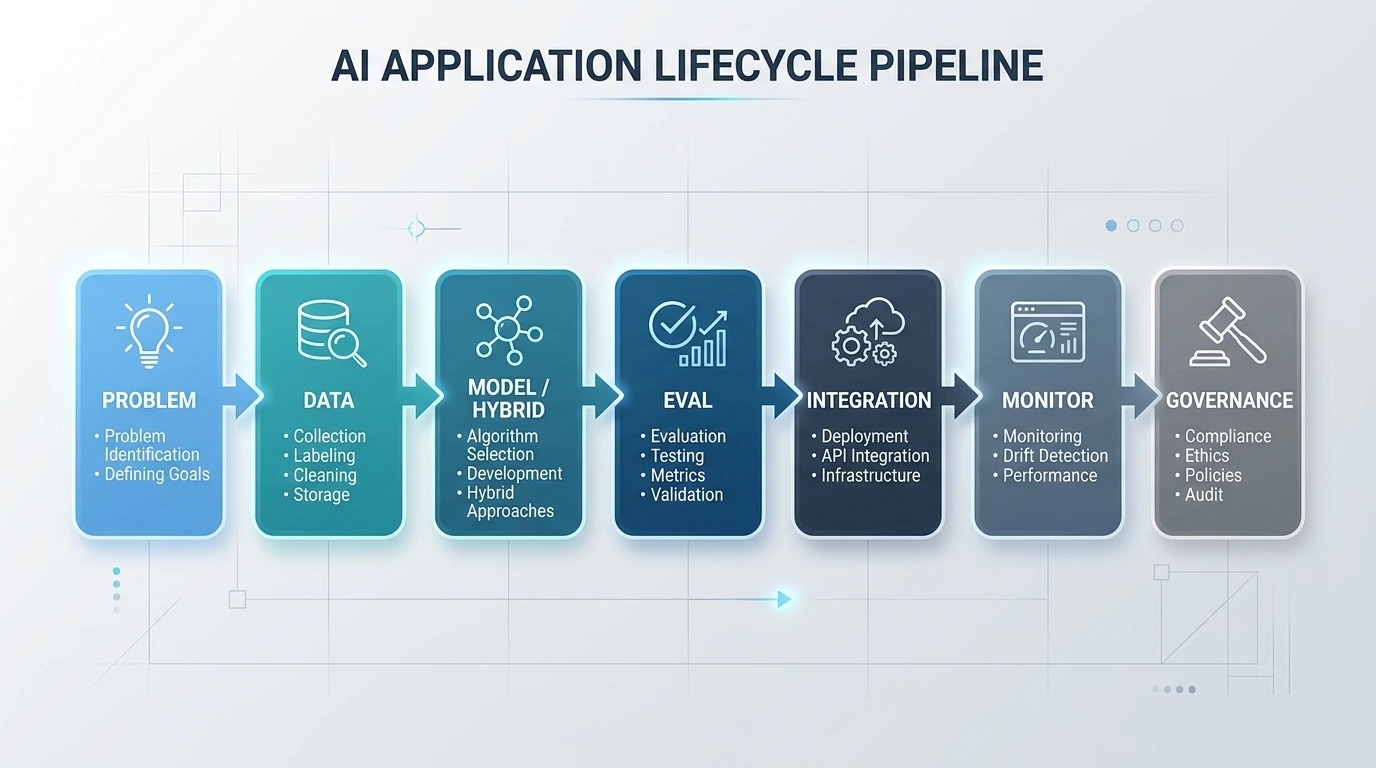
A durable assembly stack looks like: problem framing → data/contracts → model or hybrid reasoner → evaluation → integration (UI, APIs, tools) → monitoring → governance. The model is rarely more than one layer. Skipping data contracts and monitoring produces brittle launches.
Retrieval, tools, and policies wrap models in production. RAG supplies evidence; agents supply control loops; infrastructure supplies latency and cost envelopes. Application assembly chooses which wrappers are mandatory for the decision risk.
Data regimes and contracts that make capabilities real
Feedback loops—using model outputs as future labels—can amplify mistakes. If you learn from production, monitor for self-reinforcing errors and keep gold sets untouched by the loop. Contracts should state whether human corrections become training data and under what consent.
Capabilities are imaginary without data regimes: what is labeled, how often it refreshes, who may access it, and what leakage is forbidden. Contracts specify schemas, SLAs for freshness, consent, and retention. Offline datasets for training and online streams for inference can diverge—document both.
Synthetic data, human labels, and machine-generated labels have different error structures. Mixing them without tracking provenance poisons evaluation. Capability claims should cite the data regime, not only the model name.
Evaluation across task types without fake universal scores
Offline eval, shadow deploy, canary, and post-deploy monitoring are stages, not alternatives. Skipping shadow on high-impact decisions is how surprises reach customers. Define kill criteria before canary begins.
There is no universal AI score. Perception uses task metrics (mAP, WER); prediction uses calibration and decision utility; generation uses human preference, faithfulness, and safety rubrics; planning uses success under constraints and cost. Collapsing these into a single “IQ” number is vendor theater.
Evaluation must include slices: languages, sites, customer tiers, lighting, document types. Average excellence with silent subgroup failure is a product bug. Tie eval to the decision’s cost of errors.
Reliability and socio-technical failure
Runbooks must include model-specific steps: roll back model ID, freeze prompt changes, disable tools, force retrieval-only or human-only modes. Generic “restart the pod” misses the point when the bug is a prompt or index.
AI failures are socio-technical: model error, bad UI trust cues, missing fallbacks, incentive pressure to accept risky automation, and organizational confusion about ownership. Reliability engineering for AI includes graceful degradation, human escalation, and audit trails—not only higher accuracy.
Automation bias—overtrusting fluent outputs—is a recurring harm mode for generative interfaces. Design for verification where stakes warrant it.
Economics: when automation fails the cost test
Sometimes the winning design is partial automation: model drafts, human ships. That can beat full autonomy on total cost and risk. Autonomy is not a moral victory; it is an economic and safety choice.
Automation fails the cost test when error handling, review labor, infra, and incident cost exceed human baseline cost at the same quality. Pilots that ignore review labor lie. Include the cost of wrong automated actions (refunds, safety, reputation).
Unit economics connect to infrastructure ($/token, GPU hours) and to product design (when to abstain). Cheap tokens with expensive mistakes are not cheap.
Open versus proprietary structure in the stack
Evaluate portability with a drill: export weights or embeddings, re-run golden sets on an alternate provider, and time the cutover. If you cannot run the drill, you do not have an exit plan—you have a hope.
Stacks mix open weights, proprietary APIs, open tooling, and closed data. Openness is not binary: you might own fine-tunes but not pretraining data; you might self-host inference but buy embeddings. Map what you can audit, exit, and customize. Lock-in risk lives where evaluation and data pipelines cannot port.
Honest limits that marketing language hides
Long context windows do not equal long trustworthy reasoning. Tool access does not equal authorization. Multimodality does not equal calibrated understanding. Speak in mechanisms and tests.
Limits to state plainly: distribution shift; lack of guaranteed reasoning; context and tool permission boundaries; inability to be a system of record without retrieval and ACLs; weak performance on rare tails; vulnerability to injection when tools exist. Marketing that implies unbounded competence shifts liability onto your customers and your on-call.
Reading vendor claims with an evidence checklist
Beware category errors: demos on clean PDFs versus your scans; English-only benches versus your locales; “human parity” without confidence intervals or slice reports. Ask for the hardest 5% failure gallery. Vendors serious about safety show failures; vendors serious about marketing hide them.
Demand: task definition; dataset and time window; baselines; slices; failure examples; latency/cost at stated quality; security/ACL behavior; exit/export terms. If a claim lacks these, treat it as positioning. Run your golden set. Prefer bakeoffs with frozen protocols over slideware.
- What decision is automated, and what is the fallback?
- What metric gates ship, and who owns it?
- What data regime produced the quoted number?
- What happens under ACL denial, empty retrieval, or tool outage?
- What is the cost at the operating point you will actually run?
Where to go next in the Knowledge graph
Use this page as the orientation layer. Depth lives in the specialized guides. When a new capability family emerges, extend the map—do not rewrite every guide into a generic AI essay.
For hierarchical representation learning and production DL systems, read deep learning. For network mechanics, neural networks. For grounded enterprise answers, RAG. For tool-using autonomy, AI agents. For visual perception systems, computer vision. For accelerators and serving substrates, AI infrastructure. Generative modality patterns and controllability belong in the generative AI guide.
Organizational operating model for AI products
AI products need a cross-functional operating model: product owns decision framing; data/ML owns models and eval; platform owns serving and cost; security owns abuse and data boundaries; legal/compliance owns constrained uses; support owns escalation UX. RACI charts that leave “the AI” as owner produce orphan incidents.
Cadence matters: weekly quality triage, monthly cost reviews, quarterly red-teams for tool-enabled systems, and launch reviews gated by written kill criteria. Without cadence, AI launches become one-way doors.
Talent mix beats headcount. A single strong evaluation engineer can outperform a larger team that only ships features. Hire for measurement and reliability skills alongside model skills.
Pattern library: when not to use learning systems
Prefer deterministic software when rules are stable, complete, and auditable—tax calculations with clear statutes, access control checks, checksum validations. Prefer optimization/OR tools when the world is a known constraint system with an explicit objective. Prefer search and information retrieval when the need is findability rather than synthesis.
Learning systems earn their complexity when variation overwhelms hand-authored rules, when signals are statistical, or when generative interfaces materially reduce integration time and the risk is manageable with wrappers. “AI by default” is how teams burn budget on classifiers for problems that needed a dropdown.
Risk tiers and mandatory controls
Tier your use cases: low (internal summarization with easy verification), medium (customer-facing content with review), high (money, health, safety, employment, biometrics). Mandatory controls escalate: logging → human confirmation → dual control → prohibition. Publish the tiering so product teams stop renegotiating safety each sprint.
High-tier systems need change management equal to payments systems: approvals for prompt/model/index changes, staged rollout, and mandatory post-incident reviews. Treat prompts as code.
Measurement taxonomy for executives
Executives should see three dashboards that cannot be gamed in isolation: quality (decision metrics + slices), reliability (availability, latency, escalation rate), and economics ($/decision or $/token with error costs). Optimizing one while ignoring others creates brittle programs. Tie OKRs to the triad.
Avoid vanity adoption metrics (“messages sent”) as success without quality. Adoption of a wrong assistant is accelerated harm.
Artificial intelligence at product altitude is disciplined selection among capability families, assembled with data contracts, evaluation, and governance—not a synonym for any particular model class. Keep the map updated as specialized Knowledge guides deepen each layer.
When stakeholders ask “are we an AI company now?”, answer with the portfolio of decisions under measurement—not with a list of model vendors. The former is strategy; the latter is shopping.
Lifecycle of an AI decision in production
Follow a decision from birth to retirement. Framing defines the action and the non-goals. Data contracts lock inputs. Offline models or prompts are built and evaluated on golden sets. Shadow mode compares against incumbents. Canary exposes a fraction of traffic. Full release enables monitoring and periodic re-validation. Retirement removes the decision when the world or the economics change. Skipping stages is how “successful pilots” become production incidents.
Each stage has exit criteria written in advance. Example: shadow agreement ≥ X on critical slice, false-automation rate ≤ Y, p95 latency ≤ Z, and documented fallback. If criteria are invented after seeing results, they are not criteria—they are rationalizations.
Retirement is underused. Models that once paid for themselves can become net-negative when fraud patterns shift or when a simpler rules update lands. Schedule retirement reviews; do not let zombie models consume budget and risk forever.
Human roles that remain after automation
Humans remain as exception handlers, auditors, policy authors, and red-teamers. Design jobs so those roles are staffed and respected. If exceptions are punished as “failure to automate,” people will rubber-stamp model outputs and destroy the safety valve.
Training for reviewers matters: show hard negatives, teach when to override, and measure override quality—not only override rate. Untrained review is theater.
Customer support needs AI-specific macros: how to explain abstentions, how to escalate suspected model errors, and how to collect reproducible examples for the quality team. Without that, every bad answer becomes an unstructured complaint.
Interfaces that change error rates
The same model behind different UIs produces different outcomes. Interfaces that highlight uncertainty, show sources, and require confirmation on irreversible acts reduce harm. Interfaces that animate confidence and hide provenance increase automation bias. UX is part of the AI system boundary.
For assistants, separate “draft” from “send.” For analytics, separate “suggested insight” from “published metric.” For vision, separate “flag for review” from “automatic reject.” These separations are product decisions with safety consequences.
Accessibility and localization are capability issues: a system that only works for majority languages or majority lighting conditions is not the capability you claimed. Include those slices in the definition of done.
Portfolio strategy across the Knowledge stack
Organizations should portfolio their AI bets across the guides this site provides: perception systems via computer vision, grounded knowledge via RAG, autonomy via agents, representation learning via deep learning, and substrates via AI infrastructure. A portfolio that is only chatbots is concentrated risk.
Sequence investments: data foundations and evaluation harnesses before glamorous agents; retrieval and ACLs before “company brain” claims; infra observability before doubling GPU spend. Sequence beats simultaneous moonshots for most teams.
Shared platforms should expose building blocks (authz’d retrieval, model gateway, eval service) rather than a single mega-assistant. Products compose blocks; platforms that force one UX become bottlenecks.
Claim language that survives diligence
Replace “our AI understands your business” with “our system retrieves from corpus C under ACL A and answers with faithfulness score F on golden set G.” Replace “human-level” with “meets metric M on distribution D compared to baseline B.” Diligence teams increasingly demand the second dialect. Train your own marketing and sales to speak it.
Internal diligence mirrors external: before buying, run the evidence checklist; before building, write the decision contract. Both prevent narrative-driven roadmaps.
Worked decision sketches (patterns, not templates)
Document question answering for employees: capability mix is retrieval + generation + interaction. Mandatory wrappers: ACL-filtered RAG, citations, abstention, and audit logs. Discriminative classifiers may route intents before generation. Success metrics: faithfulness, retrieve recall on golden questions, time-to-answer, and zero cross-tenant leaks. Non-goals: unbounded web browsing without policy.
Warehouse defect gating: capability mix is perception (+ maybe prediction of severity). Mandatory wrappers: camera health monitoring, calibrated thresholds, human review on uncertain bands, and per-camera drift alerts. Generative models are usually irrelevant. Success metrics: precision/recall at the shipment decision, scrap cost, and escape rate.
Internal analytics assistant: capability mix is generation + tools (SQL) + interaction. Mandatory wrappers: read-only DB roles, query allowlists, row-level security, and dry-run explain plans. Success metrics: correct query rate on golden asks, zero privilege escalation, and analyst time saved after verification. Non-goals: autonomous writes.
These sketches show why a single “AI strategy” slide cannot prescribe one architecture. The decision dictates the capability mix and the mandatory controls.
Anti-patterns catalog
Model shopping without golden sets — demos win; production loses. Prompt sprawl without versioning — behavior becomes unowned. Agents without budgets — cost and risk unbounded. RAG without ACL filters — tenancy theater. Accuracy-only OKRs — ignore calibration and tails. Infra buy without utilization model — GPUs idle or overloaded. Human review without training — rubber stamps. Security bolted on after launch — injection and exfiltration arrive on day one.
Each anti-pattern maps to a missing artifact: golden set, version pin, budget, filter, slice report, capacity model, reviewer curriculum, or threat model. Demand the artifact.
From map to roadmap
Translate the capability map into a twelve-month roadmap by selecting a few high-value decisions, writing contracts, standing up eval harnesses, and only then choosing models. Parallelize platform blocks (gateway, retrieval, observability) that multiple products share. Sequence risky autonomy behind proven wrappers.
Revisit the map quarterly as specialized systems mature. When generative controllability, vision fleets, or infra unit economics change, update portfolio weights. The map is a living operating document for leadership—not a poster.
Keep stakeholder education continuous: short briefings on boundary language (AI/ML/DL/GenAI), evidence checklists, and risk tiers prevent the organization from relapsing into slogan-driven delivery.
Coordination with neighboring technical layers
This orientation layer only works if neighboring guides stay distinct. Deep learning owns representation learning systems and transfer ladders. Neural networks owns units, graphs, and inductive bias. Computer vision owns visual tasks and camera-aware metrics. RAG owns grounded retrieval pipelines. AI agents own observe–decide–act control. AI infrastructure owns accelerators, fabrics, and serving economics. When writing PRDs, link the layer you are actually changing—do not paste a generic “AI” paragraph into every ticket.
Boundary discipline prevents the Knowledge library from collapsing into one repeated essay. If two teams disagree about ownership, use the V2 overlap rules: explain the distinction in one short paragraph, then deepen only on your side of the boundary.
As Batch 1 completes, generative AI joins this set as the modality and controllability layer for sampling systems. Until that guide is live, mention generative patterns without inventing a second full generative treatise here—keep this page at capability-map altitude.
Closing operating principles
Prefer decisions over demos. Prefer contracts over vibes. Prefer slices over averages. Prefer wrappers matched to risk over model-name shopping. Prefer portable eval harnesses over irreproducible screenshots. Prefer named owners over “the AI.” These principles sound simple and fail loudly when ignored.
Organizations that internalize them ship fewer surreal assistants and more systems that survive diligence, incidents, and cost reviews. That is the practical meaning of artificial intelligence as an engineering discipline on this site.
Appendix-style reminder for writers and PMs: every AI initiative should produce four durable artifacts—decision contract, data contract, evaluation card, and operations runbook. If any artifact is missing at launch review, the default answer is “not yet.” Shipping without them transfers hidden work onto on-call engineers and support teams who did not approve the risk.
Keep those artifacts short enough to read. A twenty-page policy that nobody opens is not control. A two-page contract that names owners, metrics, fallbacks, and prohibited uses usually beats a binder. Update the artifacts when the decision changes; stale contracts are how yesterday’s chatbot becomes tomorrow’s unowned liability.
Finally, teach newcomers the boundary language early. Confusing AI, ML, deep learning, and generative AI in kickoff meetings predicts confused architecture later. Ten minutes of shared vocabulary saves months of mis-aimed builds. Revisit vocabulary when new hype terms appear; rename slides, not architectures, unless the decision contract truly changed. Write the new contract first; buy or build second; celebrate demos never.
Use this guide as the shared front door to the Knowledge library’s AI stack. Depth lives one click away in the specialized articles linked above; breadth and boundary language live here on purpose for readers and builders alike.
With generative AI now published in Batch 1, treat that guide as the controllability and modality layer beside this capability map—link both when onboarding product teams.
References and further reading
- Russell, S., & Norvig, P. Artificial Intelligence: A Modern Approach (systems and agent view).
- NIST. AI Risk Management Framework.
- ISO/IEC standards family for AI management systems (organizational controls; verify current numbers for your jurisdiction).
- Google PAIR / people+AI guidance literature on human–AI interaction patterns (design for verification).