
Artificial intelligence, in everyday language, is a family of computer systems that can perform tasks that look like perception, prediction, generation, or decision support—often by learning patterns from data rather than by following only hand-written rules. This page is an accessible on-ramp for general readers: plain definitions, how AI differs from ordinary automation and software, a capability map for newcomers, how learning systems differ from rules, the system shapes people actually meet, limits and failure intuition, a path into the Knowledge library, myths that waste time, and a clear boundary to the deeper systems guide. It is not a substitute for artificial intelligence, which owns engineering-altitude systems treatment, application assembly, and claim checklists for builders and operators.
If you are new, read this first. When you need stack depth, evaluation rigor, and vendor-evidence habits, continue to artificial intelligence. Adjacent on-ramps and foundations: machine learning, generative AI, large language models, neural networks, deep learning, supervised learning, computer vision, conversational AI, plus AI ethics, AI safety, and enterprise AI for values, hazards, and organizational use.
Plain-language definition
Start with a working definition you can reuse in conversation: AI systems estimate useful outputs from inputs under uncertainty. The inputs might be text, images, audio, sensor streams, or tables. The outputs might be labels, rankings, generated text, suggested actions, or control signals. “Useful” is defined by a human purpose—approve a claim, draft an email, detect a defect, translate a sentence—not by mystical intelligence.
Two ideas sit inside most modern AI products. First, pattern recognition at scale: the system has seen many examples and generalizes to new ones imperfectly. Second, optimization: training or tuning pushes the system toward a measurable objective, such as fewer wrong labels or preferred answers. Neither idea requires the machine to “understand” the world the way a person does. Understanding is a human word; engineering cares about behavior under tests.
Narrow AI is what you meet daily: systems competent in bounded tasks. Broad or general intelligence—human-like flexibility across arbitrary domains—is a research aspiration and a media theme, not the default description of today’s deployed tools. When a chatbot sounds versatile, it is still a system with training data, limits, and failure modes.
AI is also socio-technical. People choose objectives, collect data, design interfaces, and decide when to trust outputs. A fluent answer is not automatically a correct or fair one. Plain language should keep humans in the story: who benefits, who is harmed when the system is wrong, and who can override it.
Finally, AI is plural. There is no single algorithm behind every product. Classifiers, recommenders, speech recognizers, image generators, and tool-using assistants share a marketing umbrella while differing in mechanics and risks. The on-ramp skill is to ask “what kind of AI system is this?” before asking “is AI good or bad?”
A practical test for any definition you hear: does it help you name inputs, outputs, and stakes? If a definition only inspires awe, it is not yet useful. Prefer definitions that lead to questions you can investigate.
Another plain framing: AI is decision support under uncertainty, sometimes with the decision fully automated. The more irreversible the action, the more you should demand evaluation, oversight, and fallback. Definition debates matter less than matching caution to blast radius.
Children’s explanations and executive explanations should share the same skeleton—inputs, outputs, learning, limits—even if vocabulary changes. If the executive version promises magic the children’s version denies, someone is being misled.
Keep “intelligence” as a metaphor, not a metaphysical claim. Metaphor helps intuition; it becomes harmful when it excuses missing tests (“it’s smart, so it will handle edge cases”). Edge cases are exactly where metaphors fail.
AI versus automation versus software
All AI products are software. Not all software is AI. Ordinary software follows explicit instructions: if a form field is empty, show an error; if inventory is zero, block checkout. The behavior is authored line by line. Automation often means chaining those deterministic steps—scripts, workflows, robotic process automation—so people do less repetitive clicking. Automation can be transformative without any learning model.
AI enters when behavior is partly induced from data or from large pretrained models rather than fully specified by rules. A rules engine that flags transactions over a fixed amount is automation. A model that estimates fraud risk from many features is AI-enabled decisioning. A template email is software. A model that drafts a unique reply from a ticket is generative assistance.
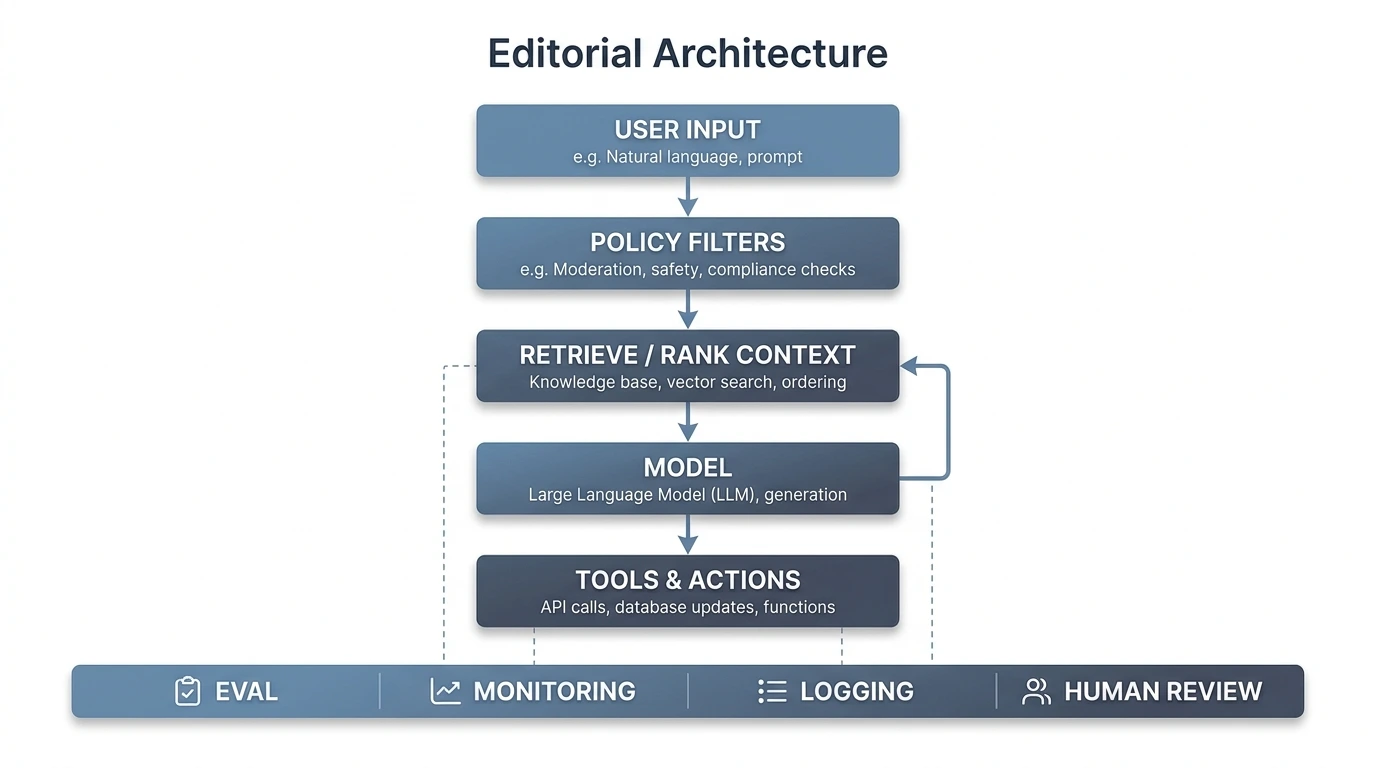
Hybrids are common and healthy. Many strong systems combine rules, databases, and models: retrieve the policy, draft with a model, validate fields with rules, require human approval above a threshold. Calling the whole stack “AI” can hide the parts that actually guarantee compliance. Calling none of it AI can hide where uncertainty lives.
Why the distinction matters for newcomers: deterministic bugs and statistical failures need different mental models. A misconfigured rule fails the same way every time until fixed. A model can be right on Monday’s data distribution and wrong on Tuesday’s shift. Oversight, testing, and trust UX should reflect that difference.
Marketing blurs the line by labeling any automation “AI.” Readers should ask whether the system learns from data, uses a pretrained model, or merely executes scripts. The answer changes what questions to ask next—about training data, evaluation, and drift—or about ordinary software quality.
Enterprise buyers meet the blur constantly. A suite may add a generative panel on top of decades of deterministic workflows. Evaluate the new uncertain component without discarding the stable core—and without assuming the panel is magic. Enterprise AI literacy is largely about placing models inside real operating constraints.
Cost structures differ. Rules are expensive to author for messy domains but cheap to run and audit. Learned systems can be cheaper to create for perception tasks yet expensive to evaluate, monitor, and revise. Total cost of ownership includes people who check outputs—not only GPU invoices.
Change management differs. Software releases can be deterministic diffs. Model changes may alter behavior without a clean line-by-line narrative. Organizations used to traditional release notes need new habits for model and prompt changelogs.
When someone says “we automated it with AI,” translate: Which steps are deterministic? Which steps are model-based? Which steps still need humans? A three-column answer prevents category error in planning.
Capability map for newcomers
A simple capability map helps you recognize what a product is trying to do:
Perception. Turn messy signals into structured observations: speech to text, images to detections, documents to fields. Computer vision is a major perception family; speech and document systems are cousins.
Prediction. Estimate an unknown: will this customer churn, is this email phishing, what demand arrives next week. Classical and modern machine learning dominate here, including supervised learning from labeled examples.
Generation. Produce new artifacts: text, images, code, audio. This is the home of generative AI and, for text, large language models.
Interaction. Maintain a dialogue or multi-turn task with a user. Conversational AI covers assistants and chat systems that may or may not be generative under the hood.
Recommendation and ranking. Order items for a goal: what to show next, which document is most relevant. Related to prediction, but the product feel is a feed or search list.
Control and assistance with tools. Suggest or take actions in other systems—sometimes called agents when loops and tools are involved. Treat action-taking systems as higher stakes than draft-only systems.
Most consumer-facing “AI” mixes capabilities. A photo app may perceive faces, generate backgrounds, and interact via chat. Naming the mix clarifies which failures to expect: wrong detection, wrong pixels, or misleading dialogue.
You do not need to memorize research taxonomies on day one. You need a habit: when you open a new AI feature, label its primary capability in one sentence. That sentence becomes your compass for demos, privacy questions, and “what could go wrong?”
| Capability | Everyday example | Newbie question to ask | Deeper guide |
|---|---|---|---|
| Perception | Scan a receipt into fields | What happens on blurry input? | Computer vision / document systems |
| Prediction | Spam or fraud scores | What is the cost of a wrong yes/no? | Machine learning |
| Generation | Draft an email | How do we verify facts? | Generative AI / LLMs |
| Interaction | Support chatbot | When does it escalate to a human? | Conversational AI |
| Tool actions | Assistant that books or sends | What can it change without approval? | Agents / enterprise practice |
Secondary capabilities appear inside primary ones. A generative assistant may quietly include retrieval (a form of search), ranking of snippets, and safety classification. You do not need to see every subsystem on day one, but you should know that “a chatbot” is often a small system of systems.
Capability maps also prevent false rivalries. Debating whether computer vision or LLMs are “more AI” wastes time. Different jobs; different metrics. Pick by task.
As you advance, you will add nuance—multimodal systems, tool use, retrieval-augmented generation—using deeper guides. The beginner map stays valuable as a pocket compass when vendors overwhelm you with trademarks.
How learning systems differ from rules
Rules encode expert judgment directly: “if temperature exceeds X, open the valve.” Learning systems encode judgment indirectly: “here are many examples of good and bad cases; fit a function that approximates the pattern.” The fitted function may be a simple statistical model or a large neural network trained with deep learning methods.
Learning helps when rules would be endless—pixels, language, and messy documents rarely yield clean if-then encyclopedias. Learning hurts when examples are biased, scarce for rare cases, or outdated. A model is a mirror of its data regime and objective, not a neutral oracle.
Supervised learning, explained further in supervised learning, learns from labeled examples. Other paradigms learn from rewards, from unlabeled structure, or from massive next-token prediction as in modern language models. As a newcomer, remember the shared theme: behavior depends on data and objective, so changing either can change outcomes without rewriting a business rulebook.
Another difference is explanation. A short rule can be read. A large model’s internal computation is hard to narrate fully. Product teams compensate with evaluations, citations, retrieval, and UI that encourages checking—not with pretending the model “thinks out loud” reliably.
Update habits differ too. Rules change when someone edits them. Models change when retrained, fine-tuned, prompted differently, or swapped for a new version. Silent updates can alter user experience. Ask whether versions are pinned and how changes are announced.
Hybrid design is normal: use learning for perception or drafting; use rules for hard constraints (“never auto-send money above limit”). Responsibility often lives in the rules and human gates around the model, not only in the model’s wit.
Feedback loops deserve beginner attention. If a system learns from its own production outputs without care, it can reinforce mistakes. Even if you never train models yourself, ask whether your clicks and corrections become training fuel and under what policy.
Evaluation is the beginner’s friend. You do not need to derive loss functions to ask: What was tested? On whose data? What fails? Who looked at the failures? Learning systems without evaluation stories are unfinished stories.
Human labels are part of learning. People annotate, preference-rate, and moderate. “AI” often includes hidden human work. Respecting that work is part of understanding how systems behave—and how they can be biased.
Common system shapes users meet
Newcomers rarely meet raw algorithms. They meet product shapes:
Scoring panels. A number or risk label appears beside a case. Your job is to learn what the score means, what it ignores, and whether a person still decides.
Assistive writers. A box proposes text. Your job is to edit, verify, and own the sent message. Fluency is not truth.
Chat interfaces. You converse with a system that may retrieve documents, call tools, or only sample likely words. Ask what it can access. Conversational AI products vary widely behind similar chat bubbles.
Search and recommenders. Results are ranked by predicted relevance or engagement. Ask what the system optimizes—and who that optimization serves.
Generators for media. Images, audio, or video from prompts. Ask about likeness rights, disclosure, and evaluation for harmful content—not only about aesthetic wow.
Embedded features. “AI” inside email, CRM, or photo apps. Settings and data paths matter: what leaves the device, what is retained, what trains future models.
Recognizing the shape tells you which mistakes are likely. Scoring systems fail quietly on edge cases. Generators fail loudly by inventing plausible falsehoods. Chat systems can mix both. Tool-using assistants can fail by taking unintended actions—so permissions deserve more attention than clever prompts.
In workplaces, the shape also tells you the operating model. A draft assistant needs review labor budgets. An automated decision needs appeal paths. Enterprise AI programs that ignore shape end up with one policy for unlike risks.
When a vendor demo jumps between shapes—chat, then autonomous agents, then analytics—pause and insist on one primary shape for the pilot. Shape-hopping demos are how scope expands past governance.
Mobile on-device features may process data locally; cloud features send data away. The UI can look identical. Shape literacy includes asking where computation runs and what is stored—basic privacy hygiene for any AI feature.
Collaborative shapes matter at work: one person’s assistant may see shared drives. Permissions, not model cleverness, determine leak potential. Beginners should treat access scope as part of the product shape.
“Autopilot” shapes that take actions need rehearsal. Practice the undo. If undo is weak, do not enable autopilot on high-stakes channels. Shape plus reversibility predicts safe defaults.
Limits and failure intuition
Build intuition with a few durable limits:
Distribution shift. Models trained on yesterday’s world misbehave when today differs—new slang, new fraud tricks, new camera angles.
Long-tail fragility. Averages can look great while rare cases fail. Rare cases are often where harm concentrates.
Confidence theater. Fluent language and crisp UI can outrun reliability. Systems may not know when they are wrong.
Context boundaries. A chatbot may lack your private documents, or may have them via connectors with permission risks. Either way, “knowing” is bounded.
Objective mismatch. Optimizing clicks is not optimizing well-being; optimizing exam scores is not optimizing job performance.
Security and misuse. Systems can be tricked, leaked through, or used for harm. AI safety studies hazards and mitigations; it is not optional reading only for researchers.
Value conflicts. Even accurate systems can be unfair or manipulative depending on design choices. AI ethics makes those conflicts explicit.
Failure intuition for generative text: inventing citations, merging two people into one biography, skipping uncertainty, and complying with bad instructions. Failure intuition for vision: impressive demos on clean photos, weaker results on your real lighting and clutter. Failure intuition for prediction: stable overall accuracy with painful errors on a protected or minority slice.
Healthy user habits: verify high-stakes facts; prefer systems that cite retrieval; keep humans for irreversible actions; watch for automation bias—the tendency to trust the machine because it sounds sure. Healthy builder habits live in the deeper artificial intelligence guide: evaluation, monitoring, and fallbacks.
Limits are not a reason to reject all AI. They are a reason to size trust to evidence. Umbrellas fail in hurricanes; that does not make umbrellas useless in rain. Match the tool to the weather.
Social limits matter: deepfakes, persuasive spam, and scaled harassment. You do not need to be a security engineer to slow down before sharing synthetic media as proof. Verification culture is civic AI literacy.
Environmental and labor footprints exist behind large systems—energy, hardware, and human review work. Beginners need not compute exact figures to ask whether a trivial use justifies a heavy tool. Proportionality is a limit intuition too.
Personal limits: skill atrophy if you never check, and overtrust if you always accept. Set personal policies—for example, always verify legal, medical, and financial statements—regardless of model confidence.
How to keep learning (path into the library)
After this on-ramp, choose a path by goal:
If you want systems vocabulary for products and claims, read artificial intelligence next. It is the deep companion to this page.
If you want how machines learn from data, read machine learning, then supervised learning, neural networks, and deep learning as needed.
If you want to understand chatbots and modern text tools, read generative AI and large language models, then conversational AI.
If images are your entry point, read computer vision and generative image topics in the library.
If your workplace is rolling out tools, read enterprise AI, and pair with AI ethics and AI safety so values and hazards are not afterthoughts.
Learning tip: alternate concepts with concrete observation. Use a tool, write down where it failed, then read the guide section that names that failure. Passive reading alone creates false fluency—the same risk models have.
Another tip: keep a personal glossary of confusing words—model, agent, training, inference—and update it when senses collide. Prefer library guides over random social explainers when stakes are high.
Do not try to read everything in a week. AI literacy is cumulative. A strong beginner outcome is being able to classify a product’s capability, name two failure modes, and know which deeper guide to open. That outcome already beats memorizing buzzwords.
If you are a student, pair this on-ramp with hands-on courses carefully: toy accuracy on clean datasets can overconfidence you for real deployments. If you are a manager, pair it with process questions: owners, review labor, and stop authority. If you are a policymaker, pair it with ethics and safety before slogans.
Join conversations carefully. Online AI discourse mixes genuine engineering, marketing, and apocalyptic theater. Use Brel guides as ballast when debates detach from mechanisms and evidence.
Practice writing a one-page brief for any tool you adopt: purpose, data used, failure modes, oversight, and exit plan. The brief is a learning artifact; update it after incidents and version changes.
Teach others what you learn. Explaining the capability map to a colleague will reveal gaps faster than rereading alone. Literacy spreads through institutions that talk plainly.
Myths that waste time—often amplified by AI news cycles
Myth: AI already understands like a person. Systems optimize objectives on data. Personhood metaphors hide evaluation work.
Myth: More parameters automatically mean better for your task. Fit to your data, latency, and cost matters. Bigger can be worse for narrow problems.
Myth: A clever prompt fixes everything. Prompts help, but data access, permissions, evaluation, and product design dominate serious use.
Myth: AI eliminates the need for experts. It often changes expert work—more review, more specification, more edge-case handling—not zero experts.
Myth: Open or closed is a moral binary that decides quality. Deployment context, evaluation, and operations decide outcomes; licensing is one factor among many.
Myth: If it is on a leaderboard, it is ready for you. Public scores are not your workflow. Demand task evidence.
Myth: Automation bias only happens to other people. Fluent outputs persuade almost everyone under time pressure. Design and habit must counter it.
Myth: Ethics is only philosophy, safety is only research, and products need neither. Real users meet value conflicts and hazards; AI ethics and AI safety are practical.
Myth: You must become a researcher to have a valid opinion. You need clear questions and the humility to follow evidence. Deep math helps builders; civic and workplace literacy help everyone.
Dropping these myths frees attention for skills that compound: defining tasks, checking outputs, understanding data paths, and knowing when not to use AI.
A final myth worth retiring: “explaining AI once is enough.” Tools change. Revisit assumptions when a new shape enters your life—especially tool-using assistants that can act, not only advise.
Myth: AI is only for technologists. Nurses, teachers, journalists, and small-business owners already meet AI shapes. Domain experts who learn failure intuition often outperform technologists who ignore domain stakes.
Myth: Regulation will automatically make products safe. Regulations set obligations; organizations still design systems. Literacy and governance remain necessary inside the law.
Myth: You must pick a tribe—acceleration or refusal. Most real decisions are contextual: where to adopt, where to abstain, where to require humans. Context beats tribal identity.
Boundary to the artificial-intelligence guide
This page owns the general-reader on-ramp: definitions in plain language, distinctions from automation, a newcomer capability map, learning-versus-rules intuition, product shapes, failure intuition, learning paths, and myth cleanup. It intentionally does not cannibalize the published artificial intelligence deep guide.
Use artificial intelligence when you need systems-altitude ownership: engineering working definitions, capability families for builders, ML/DL/generative boundaries in product language, application assembly around models, data regimes, evaluation without fake universal scores, socio-technical reliability, economics, open/proprietary structure, honest limits for operators, and vendor-claim evidence checklists. That guide’s structure is not copied here on purpose—Class C separation keeps the on-ramp readable and the deep guide authoritative.
Use machine learning, generative AI, large language models, neural networks, deep learning, supervised learning, computer vision, and conversational AI when a specific family becomes your focus. Use enterprise AI when the question is organizational adoption. Use ethics and safety guides when the question is values or hazards.
What is AI, for a careful beginner? A set of software systems that learn or approximate useful behavior under uncertainty—powerful, limited, and always embedded in human choices. Learn the shapes, respect the failures, verify what matters, and climb into the library when you need depth. Curiosity beats hype; evidence beats vibes; and the next honest step is usually a more specific guide—not a grander slogan.
Carry three questions into every new AI encounter: What capability is this? What would a believable failure look like? Who is accountable when that failure happens? If you can answer those, you have left the buzzword lobby and entered literate use. The rest of Brel Knowledge exists to deepen each answer without demanding that every reader start in the engine room. Start here; go deeper on purpose; and keep humans responsible for outcomes machines only approximate.
On-ramp exit criteria: you can explain AI versus automation in your own words; you can label a product’s primary capability; you can list two realistic failures; you know whether your next reading is systems (artificial intelligence), learning (machine learning), generative text (generative AI / LLMs), or workplace adoption (enterprise AI). When those criteria are met, you are ready to leave the on-ramp without pretending you have finished the subject.
Return to this page when a friend asks “what is AI?” and you feel yourself slipping into either dismissive cynicism or uncritical awe. The middle path—curious, mechanistic, evidence-seeking—is the literacy this on-ramp tries to install. Depth lives next door in the artificial intelligence guide and across the library; humility travels with you.