
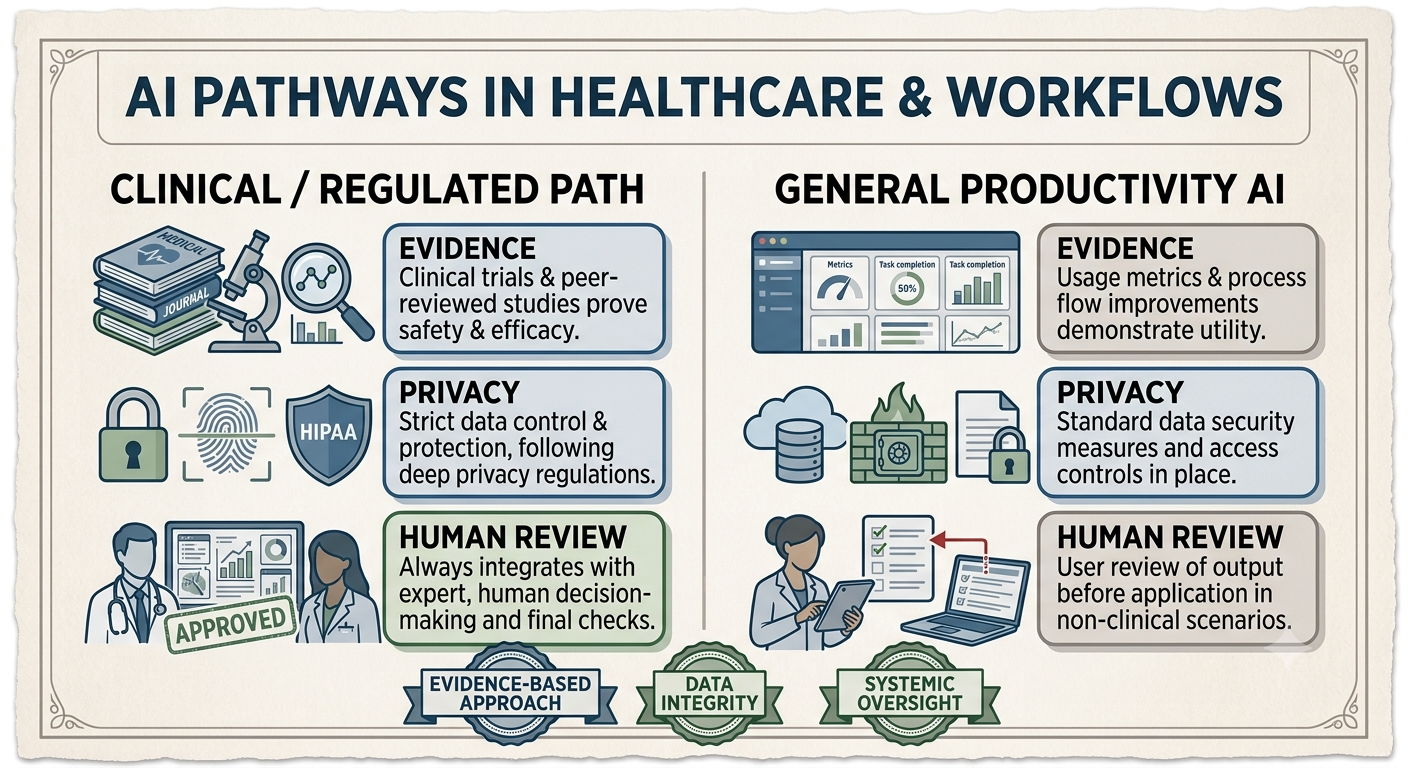
Healthcare AI applies machine learning and adjacent AI systems to clinical care, public health, research, operations, administration, and patient support. Its defining challenge is not choosing a large model. It is placing a probabilistic system inside workflows where data is sensitive, decisions are consequential, labels are imperfect, and the cost of delay or error can be unevenly distributed. This guide covers clinical workflow design, validation, human factors, PHI handling, deployment, monitoring, procurement, and retirement.
This is an engineering and governance guide, not medical advice. It does not diagnose, recommend treatment, interpret an individual’s record, or replace licensed clinical judgment. A healthcare organization must determine applicable law, regulation, professional standards, institutional policy, and clinical accountability for each use case.
Begin with the clinical or operational job
Define the job before defining the model. Examples include prioritizing worklists, extracting structured fields from documents, detecting an image finding for review, drafting a clinical note, forecasting demand, matching patients to a research cohort, or assisting revenue-cycle operations. State the user, decision, timing, input, output, escalation route, and consequence of an incorrect result.
Distinguish assistance from automation. A system that highlights a possible finding for a qualified professional has a different risk profile from one that suppresses a case, sends a patient message, changes an order, or determines eligibility without review. “Human in the loop” is not sufficient by itself; specify what the human sees, what they can challenge, how much time they have, and whether the interface creates pressure to accept the suggestion.
Map the existing workflow, including workarounds and failure modes. Identify where data is created, copied, delayed, corrected, and handed off. Many deployments fail because a technically accurate output arrives too late, appears in the wrong queue, duplicates an existing alert, or lacks the evidence a reviewer needs to act.
Choose the smallest useful intervention. A rules engine, better search, structured template, or improved interface may solve the problem with less validation and maintenance burden than a generative model. AI is justified when it improves the defined outcome under the required controls, not because it is the newest option.
Clinical safety and intended use
Write intended use and out-of-scope use in language a clinician can understand. Identify population, care setting, specialties, data modalities, operating hours, and known exclusions. A model validated on adult outpatient data should not be assumed suitable for pediatric emergency care, a new device, or a different demographic mix.
Describe the action boundary. Does the output inform, recommend, rank, draft, or execute? Can it alter a record or communicate with a patient? Does it create an alert that may cause alarm or fatigue? The more direct, irreversible, or time-critical the action, the stronger the evidence, oversight, and fallback required.
Make uncertainty visible. A confidence value is not automatically a probability of correctness and may not be calibrated for the current population. Use clear states such as positive, negative, uncertain, insufficient data, or abstain when those states map to workflow actions. A system that knows when it lacks required information is often safer than one that always produces an answer.
Provide evidence appropriate to the task. A document extraction result may show the source span. An image aid may mark the region that influenced a review, while making clear that visualization is not proof. A generated summary should link to source facts and preserve uncertainty. Explanations should help the reviewer verify the output, not create false confidence with decorative rationales.
Data quality, labels, and representativeness
Healthcare data is collected for care and administration, not automatically for machine learning. It contains missingness, coding variation, copy-forward text, measurement changes, delayed labels, selection effects, and records shaped by prior decisions. Profile data quality and provenance before training or evaluation. Document who created a field, when it becomes available, and what it actually represents.
Define the label in relation to the decision. A billing code may be a weak proxy for a clinical condition. A note that says “rule out” is not the same as a confirmed diagnosis. A treatment choice reflects clinician judgment, access, and local practice, not necessarily the optimal outcome. Use qualified domain experts to define labeling rules and adjudicate disagreement.
Prevent leakage. Features must be available at the prediction time, not added later through discharge summaries, final reports, or downstream treatment decisions. Split by patient, encounter, site, or time as appropriate. If records from the same person appear in both training and test data, results can look strong while failing on a new patient.
Evaluate across clinically meaningful slices: age bands, sex or gender where relevant, race and ethnicity where lawfully and ethically appropriate, language, disability, geography, insurance or access context, device, site, acuity, and comorbidity. Avoid treating one fairness number as a complete assessment. Review absolute error, calibration, missingness, false negatives, false positives, and workflow consequences by slice.
Keep a protected test set and a prospective validation plan. Repeatedly tuning against one retrospective set creates overfitting. Temporal validation can reveal changes in practice, devices, coding, and prevalence. External validation at another site is valuable because it tests transportability rather than memorization of local habits.
Validation from retrospective study to clinical use
Validation is a ladder, not a single accuracy claim. Start with analytical or technical verification: does the system parse inputs, produce stable outputs, and meet performance requirements? Continue with retrospective clinical evaluation on representative data, silent prospective evaluation in the live environment, workflow or usability testing, and monitored deployment with predefined stop conditions.
Choose metrics that match the job. Sensitivity and specificity may matter for a detection task; positive and negative predictive value vary with prevalence; calibration matters when scores guide prioritization; time saved and review burden matter for workflow assistance. For generative systems, assess factual support, omission, contradiction, formatting, inappropriate certainty, and clinician correction time.
Report uncertainty and confidence intervals where appropriate. Compare with a meaningful baseline: current clinician workflow, existing device, simple statistical model, or standard operating procedure. A model can achieve a statistically significant gain that is too small to matter operationally, or a high average score that hides dangerous failure in a rare but important slice.
Prospective evaluation should preserve the normal context in which users will act. If reviewers see only a model output without the time pressure, competing alerts, or source records present in practice, usability conclusions will be optimistic. Measure override, acceptance, escalation, time-to-action, missed alerts, and workarounds.
Independent review is important for high-impact use. Clinical, privacy, security, quality, legal, and operational reviewers should see the intended use, evidence, limitations, residual risk, and rollback plan. Vendor validation can inform the record but does not replace validation by the deploying organization.
Clinical human factors and workflow safety
Interfaces shape clinical behavior. Place AI output next to the source evidence, show timestamp and model status, and distinguish an AI suggestion from a verified fact. Avoid visual design that makes an unreviewed prediction look like a finalized clinical result. Give users a simple way to correct, reject, report, or escalate an output.
Alert fatigue is a safety issue. Set thresholds using workload and consequence, not only statistical performance. Group duplicate signals, suppress stale alerts, and measure how many alerts are actionable. If users learn that most warnings are wrong or irrelevant, they may ignore the one that matters.
Automation bias can persist even with a nominal review step. Train users on limitations, display disagreement and uncertainty, and sample accepted outputs for quality review. For high-impact decisions, require an explicit rationale or confirmation when appropriate. Do not punish clinicians for overriding a model when their professional judgment and policy support the override.
Design downtime and degradation behavior. Users should know when the model is unavailable, operating outside its validated scope, using stale data, or running a changed version. Provide a manual workflow that remains usable. A clinical service must not become unsafe because an optional AI endpoint is down.
PHI, privacy, and data governance
Classify protected health information and other sensitive data before it enters a model pipeline. Identify identifiers, free text, images, audio, genomic data, location, device data, and derived attributes. Minimize collection and use the least sensitive representation that can answer the operational question.
Confirm the legal and contractual basis for every data flow. Determine whether the provider is permitted to process PHI, whether a business associate or equivalent agreement is required, where data is stored and supported, how subprocessors are managed, and whether prompts or outputs are retained for training. Do not infer compliance from a product badge or a generic privacy page.
Separate environments and access. Development and evaluation should use de-identified, synthetic, or tightly controlled data when possible. Apply role-based access, tenant boundaries, encryption, audit logs, retention schedules, and deletion processes to prompts, outputs, embeddings, caches, traces, and backups. A de-identified dataset can still carry re-identification risk when combined with other information.
Document secondary use. A generated note, risk score, or extracted field may become part of the patient record and influence future care. Define who may edit it, whether it is labeled as AI-assisted, how corrections propagate, and how patients or clinicians can challenge it under applicable policy.
Never use real patient data in an unapproved consumer tool for convenience. If a vendor or internal team proposes a new data use, pause the workflow until privacy, security, clinical, and legal owners have reviewed it.
Interoperability and system integration
Healthcare AI must fit authoritative systems. Identify the source of truth for demographics, orders, results, medications, allergies, encounters, and documents. Integrate through governed interfaces and preserve provenance, timestamps, and patient or encounter identity. Do not create a shadow record that can drift from the clinical system.
Use deterministic matching and reconciliation. A wrong patient or encounter association can be more dangerous than an incorrect classification. Validate identifiers, handle merges and corrections, and fail closed when identity is ambiguous. Log which source records were used and which version of the model produced the output.
Define write behavior carefully. Read-only suggestions are different from writing a draft, signing a result, placing an order, changing a queue, or sending a patient message. Apply least privilege and require confirmation for consequential actions. Use idempotency and audit fields so retries do not duplicate orders, notes, or communications.
Plan for latency and partial failure. If the model times out, the source workflow should continue with a clear status. If an upstream record changes while processing, recheck freshness before writing. If a result is withdrawn or a model is retired, identify and review affected outputs rather than silently leaving stale predictions in place.
Generative AI in clinical settings
Generative systems can draft summaries, suggest documentation, answer questions over approved policy, translate or simplify information, and assist administrative work. Their fluent output creates a special risk: users may mistake plausible language for verified clinical fact. Require source grounding, structured templates, citation or provenance where useful, and explicit uncertainty.
Keep patient-facing and clinician-facing use cases distinct. Patient communications need readability, language access, escalation to a human, and safeguards against urgent symptoms being dismissed. Clinician tools need source traceability, workload fit, and clear accountability. Neither should imply that an AI response is medical advice without the appropriate professional and institutional context.
Do not place unrestricted clinical action tools behind a general chat interface. Separate informational retrieval from actions such as scheduling, prescription workflows, referrals, or record updates. The model may propose an operation, but policy code and authorized staff must decide whether it may occur.
Test prompt injection and data leakage in clinical corpora. A malicious document, copied instruction, or patient-supplied text must not override system policy, expose another patient’s record, or cause an external action. Retrieval must enforce access at query time and again before the content is used.
Medical imaging, signals, and multimodal data
Imaging and signal systems require attention to acquisition conditions. Scanner, protocol, site, compression, device calibration, and operator technique can change inputs. Document the validated modality and acquisition envelope, and detect when a study is outside it. A model should be able to defer rather than force a result on unsupported data.
Evaluate at the level of the intended workflow. A pixel-level metric does not show whether a radiologist or technician makes better decisions, whether reading time changes, or whether false positives create unnecessary work. Measure patient-level outcomes or validated proxies, reader performance, triage timing, and downstream consequences where feasible.
Monitor device and site drift. New equipment, reconstruction algorithms, staffing patterns, and referral populations may change prevalence and image characteristics. Maintain a prospective sampling plan and a process for reviewing performance after material environment changes.
For audio and video, address consent, bystander capture, storage, transcription errors, and language or accent coverage. Multimodal convenience should not weaken privacy or provenance requirements.
Security and resilience
Healthcare AI security protects PHI, model artifacts, identities, clinical workflows, and patient safety. Threat-model prompt injection, model extraction, data poisoning, unauthorized retrieval, insecure integrations, compromised dependencies, and misuse of privileged tools. Security controls belong at the application and infrastructure boundaries; the model should not be the sole authorization mechanism.
Use least-privilege service identities, segmented networks, signed artifacts, dependency scanning, protected registries, tenant-aware caches, and audited administrative access. Restrict egress from inference workers and keep generated code or tool execution isolated. Log enough context for incident response while minimizing sensitive payload retention.
Prepare incident playbooks for data exposure, wrong-patient association, unsafe recommendation, widespread hallucination, model drift, compromised provider, and unavailable service. Define containment: disable an action, switch to manual review, pin a prior version, revoke a key, quarantine a data source, or take a model out of the queue. Practice the response.
Resilience requires a manual fallback and recovery evidence. Back up configuration and approved artifacts, test restoration, define recovery objectives, and ensure clinical users can identify the active version. Availability targets must not encourage unsafe fail-open behavior.
Monitoring after deployment
Monitor more than uptime. Track input validity, missingness, population mix, prevalence, calibration, error samples, abstention, latency, queue delay, alert volume, override rate, clinician correction, patient complaints, and downstream outcomes. Select signals that can reveal both model deterioration and workflow harm.
Monitor slices continuously where feasible and review rare high-consequence cases deliberately. Aggregate performance can remain stable while one site, language group, device, or age band degrades. Establish thresholds and owners before launch. An alert without a defined response is an observation, not a control.
Use delayed labels carefully. Clinical outcomes may arrive after the prediction, and treatment may change the outcome being measured. Version labels and review definitions rather than rewriting historical results. Distinguish data drift from true performance drift and investigate changes in practice before retraining.
Maintain a change log for model weights, prompts, retrieval indexes, thresholds, data sources, interfaces, and user training. A minor configuration change can alter clinical behavior. Tie every output to a release identity and evaluation evidence.
Procurement and vendor accountability
Healthcare procurement should request intended-use documentation, validation evidence, data-flow diagrams, PHI terms, security controls, support model, change notification, version pinning, incident response, audit rights, and exit provisions. Ask what the vendor has not tested. A vendor’s general healthcare customer list is not evidence for your population or workflow.
Test the full integration in a controlled pilot. Include data mapping, identity matching, downtime, correction, escalation, user training, and support response. Measure task outcomes and total cost, including review time and implementation work. Establish stop criteria and do not expand scope merely because the pilot was popular.
Contract for updates and retirement. Require notice of model, data, subprocessor, region, and API changes. Define who owns outputs and evaluation data, how records are exported or deleted, how a model is withdrawn, and how affected clinical outputs are identified. Procurement, clinical leadership, privacy, security, legal, and operations should share the decision.
Implementation sequence
Start with an inventory of proposed uses and a risk tier based on clinical impact, autonomy, data sensitivity, reversibility, and population exposure. Select one narrow workflow with a named clinical owner. Define intended use, data contract, label method, success metrics, human review, manual fallback, and stop conditions.
Run retrospective and silent prospective validation, then a limited monitored release. Train users on limitations and override paths. Review quality and workflow evidence at scheduled intervals. Expand only when the evidence supports the new population, modality, site, or action boundary.
Build reusable controls into the organization’s enterprise AI operating model: approval records, data classification, vendor review, monitoring, incident response, and retirement. Use machine learning lifecycle practices for lineage and evaluation, but keep clinical accountability and patient-facing safeguards explicit.
Deployment readiness by risk
| Use-case characteristic | Minimum deployment evidence | Operational safeguards |
|---|---|---|
| Administrative, low-impact, human-reviewed | Data-flow review, task evaluation, usability test, named owner | Access control, correction path, basic monitoring, manual fallback |
| Clinical decision support | Representative and temporal or external validation, calibration, slice review | Source evidence, uncertainty, clinician override, alert-fatigue monitoring |
| Patient-facing or time-critical | Prospective workflow study, safety review, language and accessibility testing | Human escalation, urgent-care routing, outage messaging, conservative scope |
| Automated or irreversible action | High-confidence evidence, independent review, integration and failure testing | Least privilege, confirmation, idempotency, audit trail, kill switch |
These categories are decision aids, not a substitute for the organization’s formal classification. Reassess the tier when a system gains a new population, data source, modality, write permission, or autonomous step.
Connections to adjacent capabilities
Computer vision matters for imaging and visual inspection, but healthcare deployment adds acquisition validation, reader workflow, and clinical outcome evidence. AI ethics helps examine fairness, autonomy, consent, and distributional impact; it does not replace technical validation or privacy controls.
AI safety contributes hazard analysis, robustness, and human oversight. Healthcare AI also requires patient identity integrity, PHI governance, clinical escalation, and professional accountability. These boundaries should be coordinated rather than collapsed into a generic “responsible AI” checkbox.
Common healthcare AI failure modes
Common failures include training on convenient rather than representative data, using proxy labels without clinical review, leaking future information, assuming retrospective accuracy predicts workflow benefit, presenting an uncertain output as fact, adding alerts without measuring fatigue, allowing wrong-patient writes, and deploying without a manual fallback.
Organizations also overtrust vendor validation, treat de-identification as risk elimination, ignore site and device shift, fail to pin model versions, and retrain automatically on feedback that reflects clinician behavior rather than truth. Each failure points to a missing contract, owner, test, or operational control.
Closing—place clinical AI inside the broader AI sectors map
Healthcare AI should earn its place through a defined workflow benefit and evidence that matches the clinical risk. Build around intended use, representative data, prospective validation, human factors, PHI protection, identity-safe integration, monitored deployment, and a practiced fallback. Keep the system’s limitations visible and accountability with qualified people and institutions.