
AI products are commercial or operational offerings that package machine learning capabilities into something a buyer can adopt: an API, an application, a vertical suite, a platform, or infrastructure tooling. The hard part is classification and decision design—knowing what kind of product you are buying or building—not memorizing vendor logos. A strong taxonomy prevents category errors: treating a thin wrapper like a platform, treating a model API like a finished workflow, or treating a suite seat like an evaluated capability.
This guide owns AI product taxonomy and buyer/builder decision framing: product versus model versus company; surface taxonomy; integration depth; data and tenancy patterns; evaluation loops inside products; pricing and packaging shapes; governance features that matter; anti-patterns in product claims; and the boundary to vendor evaluation. Procurement scorecards and contract diligence live in evaluate AI vendor. Technical neighbors include AI APIs, ML platforms, model marketplaces, enterprise AI, AI integrations, low-code AI, generative AI, and conversational AI. This page is not a company directory and not a ranked vendor scorecard.
Product vs model vs company
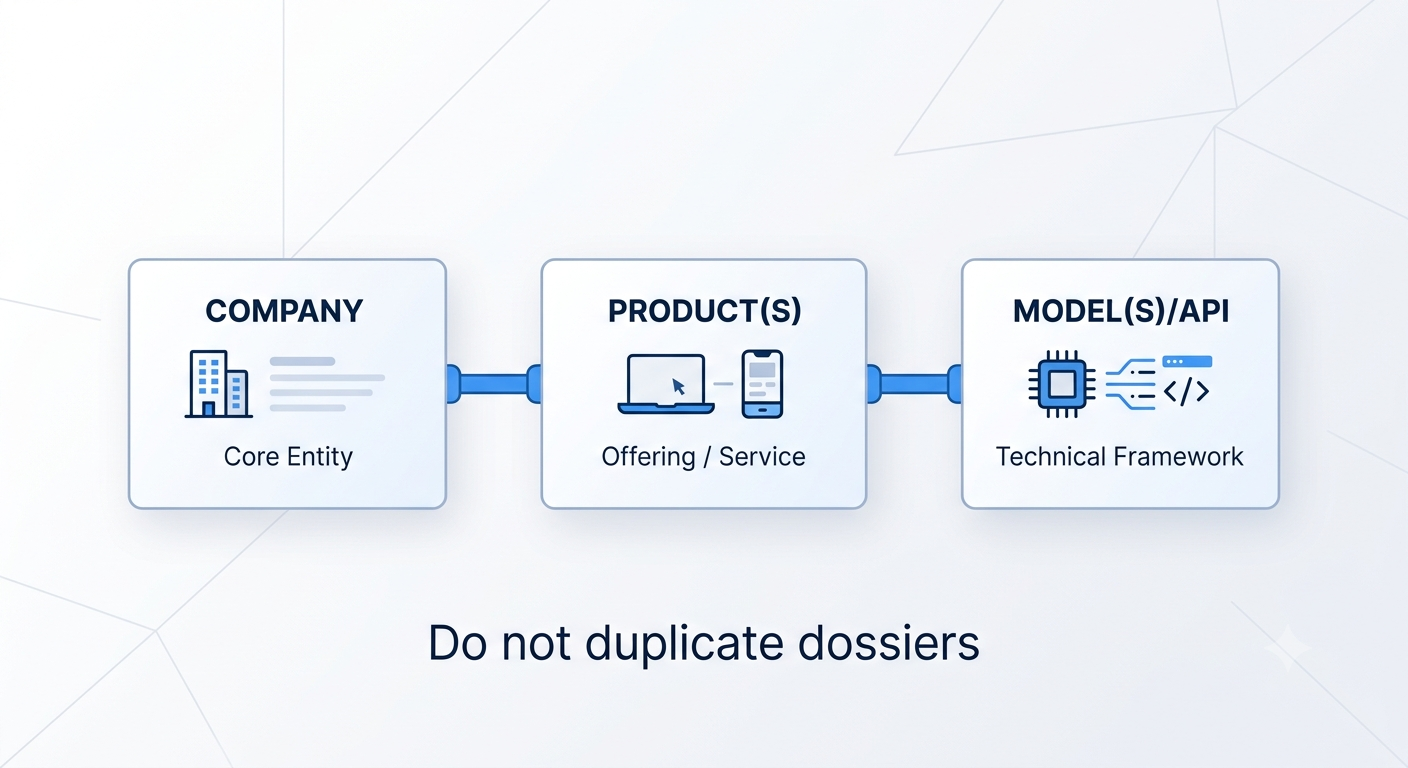
Separate three layers that marketing collapses. A model is an artifact or hosted capability that maps inputs to outputs under a learned function. A product is the operable surface around one or more models: UX, APIs, workflows, permissions, billing, monitoring, and support. A company is the legal and organizational entity that sells, staffs, and stands behind products—possibly many of them, across layers.
Why the separation matters: you can switch models inside a product; you can buy a model API without buying a workflow product; you can acquire a company and sunset the product you cared about. Decisions should name which layer holds the scarce asset you need—model quality on your tasks, workflow lock-in, distribution, data loop, or assurance packaging.
Builders should choose a home layer deliberately. Selling “AI” without choosing API versus app versus platform produces confused roadmaps and confused pricing. Buyers should write requirements against the layer: “we need an inference API with SSO and no training on our data” differs from “we need a casework assistant inside our CRM with audit logs.”
Hybrid offerings are normal. A cloud may sell models to drive platform consumption. An application vendor may fine-tune and host. A marketplace may distribute third-party models with light tooling. Classify by the primary P&L driver and the switching-cost locus, then inspect channel conflict with your other vendors.
Surface taxonomy
Use a surface taxonomy to label what the user or system actually touches:
Model / inference APIs. Programmatic access to generations, embeddings, classifications, or multimodal outputs. Strengths: flexibility, composability, multi-product reuse. Risks: you own orchestration, evaluation, UX, and much of governance. Deepen with AI APIs.
Horizontal applications. General assistants, writing tools, meeting summarizers, or image tools aimed at broad knowledge work. Strengths: fast user value. Risks: weak workflow fit, shallow permissions, unclear enterprise controls.
Vertical suites. Domain products for support, legal intake, clinical admin, claims, coding, or industrial inspection—where the product encodes process. Strengths: vocabulary, templates, integrations. Risks: vendor process assumptions mismatch your policy.
Conversational and agent surfaces. Chat, voice, or tool-using agents that plan multi-step work. Strengths: low training burden for users. Risks: autonomy without guardrails, brittle tool use, audit gaps. See conversational AI and agent-related Knowledge neighbors for interaction patterns; keep taxonomy focus here.
ML platforms and MLOps suites. Train, track, deploy, monitor. Strengths: team leverage for custom models. Risks: platform sprawl and unused shelves. See ML platforms.
Model marketplaces and hubs. Discovery and distribution of models/artifacts. Strengths: choice and experimentation. Risks: license and provenance complexity—see model marketplaces.
Infrastructure and tooling. Vector stores, feature stores, observability, gateways, evaluation harnesses, safety filters. Strengths: picks-and-shovels leverage. Risks: integration tax and overlapping tools.
Low-code / builder surfaces. Drag-drop agents, prompt apps, and citizen-developer flows. Strengths: speed. Risks: shadow IT and weak evaluation—see low-code AI.
Embedded AI features. Capabilities inside existing SaaS (CRM, ERP, IDE, office suites). Strengths: distribution and context. Risks: unclear data paths and limited exit.
| Surface | Buyer owns | Vendor owns | Typical failure |
|---|---|---|---|
| Inference API | UX, eval, orchestration | Model service | Integration without product value |
| Horizontal app | Policy, adoption | UX + model | Shallow fit; sprawl of seats |
| Vertical suite | Process change | Workflow + domain | Process mismatch; lock-in |
| ML platform | Models + data ops | Toolchain | Shelfware; skill gap |
| Embedded feature | Config + oversight | Host product AI | Opaque data use; weak export |
Integration depth
Integration depth is often the real product. A chatbot in a browser tab is shallow. A system that reads and writes your case objects, respects roles, triggers workflows, and logs to your SIEM is deep. Depth drives value and lock-in together.
Map depth along: identity (SSO, SCIM, service accounts); data connectors; write-back permissions; webhook and eventing; offline/batch modes; private networking; and admin controls for who may enable AI features. AI integrations covers patterns; here the taxonomy question is how much of the buyer’s system of record the product touches.
Builders should productize integration as carefully as model quality. A slightly worse model with reliable connectors and permissions beats a brilliant model that cannot enter the workflow safely. Buyers should price implementation and change management into the product decision—not only list fees.
Composability versus suite gravity is a strategic fork. Best-of-breed APIs plus internal orchestration maximize control and evaluation; suites maximize time-to-value and single-throat-to-choke support. Many enterprises mix both and need explicit architecture principles to avoid duplicate spend.
Depth also includes failure integration: how does the product behave when the model times out, when retrieval is empty, when a connector loses auth, or when a human rejects a suggestion? Products that only shine on the happy path are misclassified as production-ready. Require degrade paths and dead-letter handling as part of the surface definition.
Marketplace and ecosystem integrations add another depth axis: whether the product can be installed from a cloud marketplace, whether it inherits enterprise billing, and whether partner plugins expand or break the trust boundary. Treat plugin ecosystems as part of the product threat model, not as free upside.
For embedded AI inside host suites, integration depth is inherited—and so are limitations. You may gain context from CRM fields while losing exportability and model choice. Classify embedded features as a distinct surface so you do not expect API-grade portability from a checkbox in an office suite.
Data and tenancy patterns
Product class implies data pattern. Common patterns include: ephemeral inference with minimal retention; retained prompts for product improvement (opt-in or opt-out); per-tenant indexes for RAG; fine-tuned adapters per customer; shared foundation models with strict isolation of customer content; and on-prem or VPC-deployed stacks for high-sensitivity workloads.
Tenancy questions to force into the taxonomy label: Is isolation logical or cryptographic? Are embeddings and caches tenant-scoped? Do support staff access content by default? Does deletion propagate to vectors, logs, and fine-tunes? Can residency be pinned?
Mis-labeling is dangerous. Calling something “private AI” when it only disables training but retains prompts for 30 days in a shared region confuses buyers. Calling something “on-prem” when the license key phones home daily is equally confused. Precise pattern names beat adjectives.
Generative products amplify exfiltration and hallucinated write-back risks. Classification should note whether the product can export data via tools, plugins, or connectors—and whether those paths are admin-gated. Tie generative capability claims to generative AI without turning this page into a techniques manual.
Multi-tenant RAG products deserve special scrutiny: whose documents enter whose index, how authorization filters retrieval, and whether prompt injection can cross tenant boundaries via shared tools. If the product cannot explain retrieval authorization, it is not ready for regulated multi-tenant use.
Training and improvement loops should be explicit product settings, not buried footnotes. Buyers need to know whether feedback, edits, and uploaded files improve a shared model, a tenant adapter, or nothing at all. Builders who blur this line create procurement dead ends and trust debt.
Data residency packaging often splits SKUs: standard SaaS, regional cloud, and customer-managed deployments. Taxonomy should treat these as related but different products when control planes and feature parity diverge. Feature gaps between tiers are part of the classification, not fine print.
Evaluation loops inside products
Mature AI products include evaluation loops: offline golden sets, online feedback, quality queues, abstain rates, and regression gates on model or prompt changes. Immature products ship demos and rely on users as unpaid red teams.
Buyers should ask what evaluation the vendor runs continuously, what the customer can configure, and whether customers can bring their own eval harness. Builders should treat eval as a product surface—not only an internal ML chore—especially for enterprise tiers.
Human-in-the-loop features are part of the product: review UIs, escalation, reason codes, and override analytics. Taxonomy should note whether oversight is real or cosmetic. A “review button” without evidence spans or time budget is not an oversight design.
Versioning belongs here. Products that silently swap models change behavior under the same SKU. Prefer products that pin versions, publish changelogs, and allow staged rollout. That operational honesty is a product attribute, not a nice-to-have.
Online evaluation must respect privacy. Thumbs-up telemetry that ships raw prompts to a shared store may violate the product’s own tenancy story. Prefer aggregated quality metrics, sampled review under contract, and customer-controlled feedback sinks for sensitive deployments.
Slice-aware evaluation is a product differentiator: language, region, document type, customer tier, or case severity. Products that only report a global “satisfaction” score hide the failures that create incidents. Ask for slice reports in the class of work you buy.
For API products, evaluation loops often live in the customer’s code. The product still helps by offering tracing hooks, structured error codes, and stable fixtures for regression tests. An API that is hard to test is an incomplete product for enterprise builders—see AI APIs.
Pricing and packaging shapes
Pricing shapes reveal product class. Common shapes: token or request usage; seats; hybrid seat-plus-usage; outcome-based experiments; platform fees plus consumption; marketplace list prices with cloud commit drawdown; and professional services bundles that dwarf software fees.
Read packaging for incentive alignment. Pure usage pricing can punish evaluation traffic and encourage dangerous caching shortcuts. Pure seat pricing can encourage broad enablement without workflow ROI. Outcome pricing needs careful metering definitions to avoid disputes.
Total cost includes egress, support tiers, premium governance features, dedicated capacity, and implementation. A cheap horizontal seat can become expensive when every team buys a duplicate. A expensive vertical suite can be cheaper when it replaces three tools and reduces incident rate.
Builders should pick a packaging that matches the value metric customers feel—documents processed, cases resolved, developers active—while remaining measurable and hard to game. Buyers should model cost at expected and peak load, including failure retries and human review time.
Packaging also encodes product ambition. “Free forever” tiers may be distribution plays that monetize later through seats or usage; enterprise SKUs may gate the very evaluation and audit features buyers need to trust the free tier. Classify the SKU you can actually operate under policy—not the demo SKU.
Credit bundles and prepaid commit confuse comparisons across vendors. Normalize to unit cost at your forecast volume, including overage rules and whether unused credits expire. Without that normalization, taxonomy conversations collapse into incompatible sticker prices.
Services attach rates matter. If half the year-one spend is custom integration, you are partly buying a services business wrapped around software. That is valid—just label it so renewals and margin expectations stay honest.
Governance features that matter
Governance features are product differentiators for enterprise and public-sector buyers: role-based access; data retention controls; region pins; audit logs with prompt/response metadata appropriate to classification; DLP connectors; policy filters; key management; customer-managed keys; and export/delete tooling.
Not every product needs every control. Match controls to risk class. A public marketing copy helper differs from a benefits-eligibility assistant. Enterprise AI program governance still requires organizational process; product features only make that process operable.
Avoid governance theater: badges without enforceable admin controls, “compliant” claims without mapped controls, or ethics pages disconnected from product settings. Prefer features you can test in a trial tenant.
Agentic products raise governance stakes: tool permissions, spend limits, allowlists, and human approval gates are part of the SKU definition. If the product cannot express least privilege for tools, it may be the wrong class for your autonomy ambitions.
Admin experience is part of governance product quality. Controls buried in undocumented APIs, or defaults that enable broad access “for the pilot,” create permanent risk. Look for policy-as-code export, break-glass procedures, and clear separation between builder roles and end-user roles—especially in low-code surfaces.
Evidence packs travel with serious products: architecture diagrams, subprocessors, retention matrices, and mapping to the buyer’s control frameworks. Products that cannot produce these under NDA force the buyer to invent assurance from screenshots. That is a taxonomy smell: you may be buying a consumer surface dressed for enterprise.
Anti-patterns in product claims—keep product nodes coherent in the entity graph
Common anti-patterns: claiming “platform” for a single app; claiming “agent” for a scripted chatbot; claiming “accurate” without task definition; claiming “secure” without tenancy detail; claiming “enterprise-ready” because SSO exists; claiming benchmark crowns as workflow proof; claiming replacement of human professionals without oversight design; and claiming infinite memory or perfect retrieval.
Another anti-pattern is category hopping in successive releases—API one quarter, suite the next—without architectural coherence. Buyers should ask which surface is durable. Builders should resist investor storytelling that forces premature horizontal expansion.
Directory anti-pattern: reducing products to logo grids. Taxonomy plus evidence beats lists. If you need vendor selection method, leave this page.
Also watch “all-in-one AI OS” claims that collapse API, app, marketplace, and governance into one buzzword. If the product cannot show distinct admin surfaces for each job, it is probably a suite with ambitions—not an operating system. Precision in labeling protects roadmaps and procurement alike.
Boundary to vendor evaluation
Use this guide to classify what you need and to interpret what a seller is actually selling. Use evaluate AI vendor to score evidence, contracts, security, economics, and exit for a shortlist. Taxonomy without diligence is tourism; diligence without taxonomy compares apples to agent frameworks.
Practical sequence: (1) write the job and risk class; (2) pick the surface class that fits; (3) constrain data/tenancy pattern; (4) shortlist products in that class; (5) run vendor evaluation on your tasks; (6) pilot with eval loops and governance settings enabled; (7) decide with exit tests. Keep the sequence written so stakeholders cannot skip to demos.
Builders mirror the sequence inward: choose surface, design integration and tenancy honestly, instrument evaluation, package governance for the buyer you want, and avoid claim anti-patterns that create churn and distrust. Document the chosen surface class in the product brief so roadmap debates stay grounded.
AI products succeed when the package matches the job: clear surface, honest data pattern, integrable depth, measurable quality loop, coherent price, and operable controls. Classify first—then evaluate—then adopt. That is the decision guide this page owns. Revisit the taxonomy when a vendor renames SKUs; labels change faster than architectures, and your internal register should track surface class separately from marketing names.
When comparing two products that look similar on a feature matrix, force a walkthrough of one real workflow end to end: identity, data ingress, model or prompt version pinned at run time, tool permissions, human review queue, export formats, and audit log completeness. The product that cannot demonstrate those steps under your tenancy model is not “almost ready”—it is still a demo. Tie that walkthrough back to your enterprise AI operating model and your integration constraints before negotiating price.