
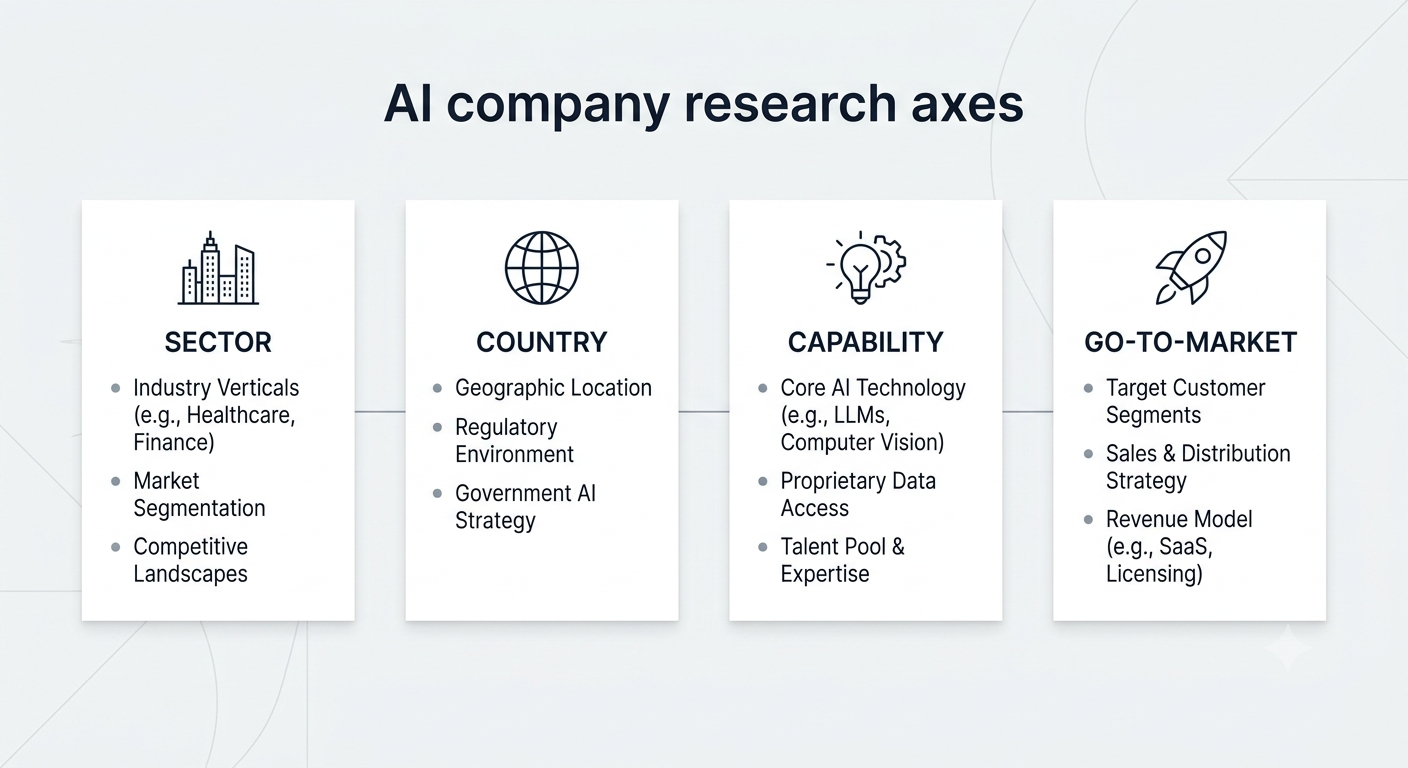
An AI company, for intelligence purposes, is a legal and commercial entity that develops, sells, or operates products or services in which machine learning or related AI capabilities are material to the value proposition—or that supplies critical inputs (models, data, compute, tooling) to those products. This page owns company intelligence method: how to treat the company as an entity type, which fields matter, how to verify claims, how relationship edges should be modeled as method (not as a scraped dump), how to avoid brochure copy, and how to use company pages with the Knowledge library. It is not a dump of hundreds of company names, not a ranked leaderboard, and not a substitute for product or lab guides.
Adjacent literacy: AI industry for stack structure, AI products for surface taxonomy, evaluate AI vendor for procurement evidence, AI research labs for lab versus company boundaries, AI funding for capital signals, and enterprise AI for buyer operating reality. Method beats memorized logo walls.
Company as entity type
Treat “company” as a first-class entity with stable identity, not as a synonym for a product, a model, or a founder. A single company may ship multiple products, host multiple models, operate under multiple brands, and change legal parents through acquisition. Confusing these layers produces broken directories and broken diligence.
Entity typing answers: Is this a commercial seller, a research institution with a commercial arm, a subsidiary of a larger conglomerate, a project brand without a clear contracting party, or a marketplace that aggregates others? Contracting and accountability attach to the legal seller—not to the demo brand name.
Identity hygiene includes legal name, trade names, jurisdictions of incorporation, and known parent/subsidiary links when evidenced. Do not invent corporate trees. When ownership is unclear, record uncertainty rather than forcing a neat org chart.
Time matters. Companies rebrand, pivot from tooling to models, or reverse from model labs into application sellers. An entity record needs an as-of discipline: what was true when verified. Stale “is an AI company” labels without dates become folklore.
Scope discipline also matters. Not every firm that uses a classifier in a back office belongs in an AI company directory concept. Inclusion should require material AI product or infrastructure value—otherwise the directory becomes “all software.” Publish inclusion rules; revise them deliberately.
Separate discovery entities from diligence entities. A lightweight card may exist for awareness; a diligence-grade profile requires verified fields and sources. Mixing the two grades without labels trains readers to overtrust thin pages.
Entity resolution is part of the method. The same firm may appear under abbreviations, product names, and former brands. Maintain alias lists with evidence, and prefer canonical legal or primary trade names for the node title. Do not merge distinct legal entities because their marketing shares a color palette.
Inactive, pivoted, and acquired states need explicit status fields. “AI company” as an eternal label on a firm that sold its model division and became a services shop misleads readers. Status should be reviewed on a cadence matched to market velocity.
Open-source project brands complicate typing. Some are foundations, some are companies sponsoring projects, some are dual. Record the contracting party for commercial support separately from the project brand when both exist.
Fields that matter (product, model, infra, data)
Useful company intelligence centers on operable fields, not adjectives. Core field groups:
Identity and commercial basics. Legal/trade names, HQ region (when evidenced), primary customer segments (enterprise, developer, consumer, public sector), and go-to-market motion at a high level. Avoid inventing employee counts or revenue.
Product surfaces. What is sold: API, app, vertical suite, platform, marketplace, infra, services, or hybrid. Map each major surface using AI products vocabulary. A company page without product-surface clarity is a brochure.
Model posture. Does the firm train frontier models, fine-tune, host third-party models, or wrap APIs? Model posture determines evaluation and lock-in risk. Link concepts to AI models thinking without dumping model catalogs here.
Infrastructure posture. Cloud dependency, self-hosted options, regional processing claims, and whether the firm is primarily a consumer or provider of compute. Infra posture affects residency and continuity analysis.
Data posture. What customer data is required, what is retained, whether customer content trains models, and what export/delete paths exist at a claim level—to be verified in procurement, not accepted from marketing.
Assurance posture. Public security pages, compliance attestations claimed, and whether documentation is concrete enough to test. Absence is information; vague “enterprise-grade” language is not a field value.
Field completeness should be graded. Unknown is a valid value. Invented precision is not. Prefer empty-with-date over fabricated certainty.
| Field group | Example questions | Bad substitute | Where to deepen |
|---|---|---|---|
| Product surfaces | API, app, suite, platform, infra? | “AI-powered platform” slogan | AI products taxonomy |
| Model posture | Train, host, fine-tune, wrap? | Model name dropping only | Models / LLM guides |
| Data posture | Retention, training use, export? | “We take privacy seriously” | Vendor evaluation |
| Commercial motion | Self-serve, sales-led, services? | Unsourced “fastest growing” | Enterprise AI context |
| Continuity | Parent entity, support path | Logo wall partnerships | Funding + contracts |
Add operating-region and support-language fields when evidenced; they often decide enterprise fit faster than model brand names. Add packaging fields: self-serve, sales-assisted, or services-led. Packaging predicts implementation risk and who shows up when something breaks.
Pricing posture belongs as a qualitative field—usage-based, seat-based, outcome-based, or hybrid—without inventing rate cards. Point readers to verify current pricing in primary sources. Stale copied prices are worse than no prices.
Security and compliance fields should list concrete claim types (for example, “publishes a trust center,” “offers DPA,” “documents subprocessors”) rather than dumping certificate theater. Certificates expire and scopes vary; the field is “what documentation exists to start diligence,” not “safe forever.”
For model-heavy firms, record whether customers can pin versions and how deprecations are communicated. Version discipline is a company-intelligence field because it predicts evaluation drift and incident load for buyers.
Verification hygiene
Verification hygiene is the difference between an intelligence directory and a marketing mirror. Every non-obvious field should carry a source class: primary company disclosure, regulator filing, customer-visible product behavior, reputable secondary reporting, or unverified claim. Do not launder social screenshots into facts.
Prefer primary evidence for product capabilities: docs, API references, admin consoles, and contractual exhibits obtained under NDA in diligence. Prefer primary evidence for legal identity: registries and official filings where available. Treat press as a pointer to primary sources, not as the source.
Contradiction handling: when docs and marketing disagree, docs win until sales confirms a change in writing. When two secondary sources disagree, mark the field disputed. Do not average rumors into a confident sentence.
Freshness: set review cadences by volatility. Pricing pages and model menus change often; incorporation jurisdiction changes rarely. A company profile without last-reviewed metadata decays into fiction.
Anti-patterns: copying “about” paragraphs verbatim; asserting customer logos without checking whether the logo page is aspirational; converting funding headlines into quality scores; and filling empty fields with generative guesswork. Generative fill without evidence is contamination.
For buyers, verification peaks in evaluate AI vendor processes: task packs, security reviews, and contract tests. Directory method prepares questions; procurement answers them.
Create a verification ladder: L0 claim from marketing; L1 claim from product docs; L2 claim reproduced in a controlled test; L3 claim backed by contract exhibit. Directory pages should rarely assert above L1 without editorial review. Procurement aims for L2/L3 on critical path items.
Multi-source agreement is not automatic truth—correlated secondary blogs can agree on an error. Independence of sources matters. One primary doc beats five remix articles.
Handle takedown and correction paths. If a company disputes a field, require their primary evidence and date the correction. Intelligence methods without appeal become propaganda pipelines.
Relationship edges (customer, partner, investor—method only)
Companies sit in graphs of relationships. Methodologically, edges should be typed, evidenced, and dated—not scraped into a fake complete network. Common edge types for an AI company concept:
Sells-to / customer. Evidenced by named case studies with dates, filings, or direct confirmation—not by logo walls alone. Strength can be qualitative (named production vs pilot language) without inventing spend.
Partners-with. Technology alliance, reseller, marketplace listing, or co-sell. Specify the partner type; “partner” alone is mush.
Investor / invested-in. Use AI funding literacy: instrument and stage matter. Do not invent round sizes. If amount is unverified, omit the number.
Parent / subsidiary / acquired. Only when evidenced. Acquisitions change contracting parties and roadmap risk; record transition uncertainty.
Uses-model-of / hosts-on. Dependency edges to model providers or clouds. These edges often matter more to buyers than vanity partnerships.
Spins-out-of / affiliated-lab. Connect carefully to AI research labs concepts: lab affiliation is not automatic product quality, and commercial arms may diverge from research brands.
Edge hygiene rules: no edge without evidence class; no undated edges for volatile claims; no reciprocal edges assumed (“they partner” does not prove equal commitment); and no bulk import of unverified relationship CSVs into reader-facing pages.
This section is method only. It does not authorize publishing a fabricated live relationship dump. Incomplete graphs with honest gaps beat dense graphs of fiction.
Negative evidence is also method: “no public production customer named as of date” is a valid statement. It is not an insult; it is a coverage note. Pressure to invent logos to make a page look finished is how fiction enters directories.
Marketplace edges deserve subtypes: listed on a cloud marketplace, sold via ISV program, or merely mentioned in a blog. Each subtype implies different support and billing realities. Flattening them into “partnered with cloud X” loses signal.
People edges should stay minimal on company pages: public CEO/CTO when relevant to accountability narratives, not exhaustive employee graphs. Person-company links belong to a sparse public-facts policy.
Avoiding brochure copy
Brochure copy is language that sounds specific while remaining untestable: “reimagining intelligence,” “trusted by enterprises worldwide,” “state-of-the-art,” “seamless,” “end-to-end AI.” Intelligence writing replaces slogans with observables.
Rewrite tests: Can a skeptical engineer falsify the sentence in a week? If not, cut or demote it to “company claim.” Prefer “offers an inference API with documented rate limits” over “empowers developers globally.”
Keep voice neutral. Directory concepts that cheerlead become advertising. Praise belongs in dated reviews with methods—not in entity baselines.
Strip superlatives and unverified rankings. Do not say “leading” unless you define the metric and the population—and even then, prefer linking readers to ranking literacy rather than asserting leadership here.
Quote marketing sparingly and label it as marketing. Paraphrase product facts from docs. When only marketing exists, say the public record is thin—that is itself intelligence.
For enterprise AI buyers, brochure allergy is a risk control. Fluent nonsense correlates with expensive pilots that never reach production telemetry.
Watch borrowed authority: “built with the same techniques as leading labs” without mechanisms; “bank-grade” without controls you can map; “human-level” without task definition. Replace with what was measured and what remains unknown.
Keep comparative language out unless you ran a comparison. “Better than legacy software” is a claim needing a baseline. Company intelligence baselines are rare; omit the comparison.
Translate metaphors. “AI brain,” “digital employee,” and “autopilot” obscure permissions and failure modes. Prefer operational nouns: model, workflow, reviewer, fallback.
Using company pages with Knowledge
Company pages and Knowledge guides serve different jobs. Knowledge explains methods, systems, and literacy. Company pages instantiate entities. Readers should move between them deliberately.
Pattern: read AI industry to know which layer you are shopping; read AI products to name the surface; open company profiles to see who sells that surface; run evaluate AI vendor for the shortlist; use AI funding only as continuity context—not as a score.
Knowledge should not become a shadow company database. Long Knowledge articles that list dozens of firms age badly and invite capture. Keep firm-specific facts on entity pages with review dates; keep durable method here.
Conversely, company pages should not reinvent governance, ethics, or ML tutorials. Link out to the guides that own those topics. Entity pages that paste encyclopedia chapters become unmaintainable.
Editorial workflow: when a Knowledge claim needs an example firm, prefer minimal, evidenced mentions or omit names. Invented “examples” are still inventions. Qualitative patterns (“application vendors wrapping foundation APIs”) often teach better than fake case lists.
Editorial SLAs help: when a Knowledge guide changes a definition that company fields depend on—such as what counts as a platform—schedule a field migration pass. Without SLAs, company pages fossilize around obsolete vocabulary.
Search UX should surface company pages for entity queries and Knowledge guides for “how/why” queries. If company pages start ranking for “what is fine-tuning,” the IA is leaking. Fix with titles, intros, and internal links that re-route readers.
Boundary to products, labs, funding, and rankings
This page owns company-as-entity intelligence method for an AI company directory concept. Boundaries:
Use AI products when the object of analysis is the sellable surface and packaging. Use AI research labs when the object is research organizations, publication norms, and lab–commercial blur. Use AI funding when the object is capital formation and how to read raises. Use AI industry when the object is value-chain structure. Use evaluate AI vendor when the object is a buying decision. Use enterprise AI when the object is operating AI inside an organization.
Do not turn this page into a top-companies ranking, a funding leaderboard, or a scraped name dump. Do not invent employee counts, valuations, market shares, or customer rosters. Do not treat partnership logos as verified edges.
A healthy AI company intelligence practice keeps identity clear, fields testable, relationships evidenced, copy restrained, and links to Knowledge intentional. The directory concept exists to reduce confusion—not to manufacture a false sense that the ecosystem has been fully mapped. Map what you can verify; label what you cannot; update what changes; and let procurement—not prose—decide who you trust with your workflows and data.
Operational checklist for editors maintaining company intelligence: (1) confirm entity type and legal seller; (2) list product surfaces with docs links; (3) note model/infra/data posture at claim level; (4) mark verification ladder per critical field; (5) add only evidenced relationship edges; (6) strip brochure adjectives; (7) set next review date; (8) link readers to the Knowledge guide that matches their question instead of pasting tutorials onto the company page.
Buyer checklist when reading a company page: treat it as a hypothesis generator. Convert fields into questions for security questionnaires and bakeoffs. If a page is thin, that is a signal to slow procurement—not a signal to fill gaps with generative guesswork.
Community and ecosystem notes can exist as qualitative context—“active developer forum,” “primarily services-led delivery”—without turning into influencer scoreboards. Influence metrics without methods are rankings in disguise; this page refuses that disguise.
When capital headlines dominate a firm’s public story, force a dual read: funding literacy for continuity hypotheses, product-surface literacy for what customers actually touch. Never let a raise rewrite the entity type from “wrapper app” into “foundation lab” without evidence.
Company intelligence compounds when aliases, status, and edges are maintained. It collapses when pages become mirror images of About sections. The durable asset is method: typed entities, testable fields, evidenced relationships, and disciplined links into Knowledge. Practice that method and the directory concept stays trustworthy even while the underlying market churns. Completeness is a horizon, not a deliverable you fake.